The Architecture of Surrender: Why Whales Dictated the Design of Norway's Newest Museum
For millennia, humans built monuments to conquer the wild. But on the freezing shores of Andøya, a radical shift is underway. Designed to erode and camouflage into the Arctic rock, The Whale museum is not a symbol of human hubris—it is a colossal monument to our surrender.
Three thousand meters below the surface of the ocean, there is no light. At this crushing depth, human biology would fail in seconds. Yet, for the male sperm whale (Physeter macrocephalus), which has been recorded diving to these extreme limits, the pitch-black abyss is anything but empty. Navigating through a landscape they can only "see" through sound, these giants emit rapid acoustic clicks, mapping the size, texture, and speed of deep-sea prey with a biological sonar more advanced than any human technology.
They inhabit a parallel reality entirely dictated by acoustic waves and echolocation. Furthermore, their massive brains are equipped with spindle cell neurons—the very same cells responsible for empathy, intuition, and complex social behavior in humans. Down in the dark, they are not solitary monsters wandering aimlessly, but highly intelligent societies speaking in ancient dialects.
Above the surface, however, architectural history has been a vastly different story—one chronicling humanity’s relentless struggle to dominate nature. For millennia, civilizations have sought to prove themselves the absolute rulers of the planet by clearing forests, diverting rivers, and erecting colossal monuments that defy gravity. From the aqueducts of ancient Rome to the glass-and-steel skyscrapers of modern metropolises, every structure has been designed as a symbol of triumph over the wild. We have long defined "progress" as the ability to bend the environment to our own needs.
But today, exactly at the edge of this submerged, alien universe, a profound spatial revolution is quietly unfolding. Three hundred kilometers north of the Arctic Circle, on the freezing shores of the Norwegian island of Andøya, a new structure is proving that buildings can be designed to yield to nature rather than conquer it. Its boundaries, location, and architectural soul were dictated entirely by the whales, far beyond the drafting table of any urban planner.
An Invisible Ecological Engine
Looking out from the desolate coast of Andøya, the ocean appears as a mundane, flat expanse of water. Yet, just a few miles offshore, the earth's crust is abruptly torn apart by a geological anomaly, plunging over 1,000 meters into the Bleiksdjupa submarine canyon.
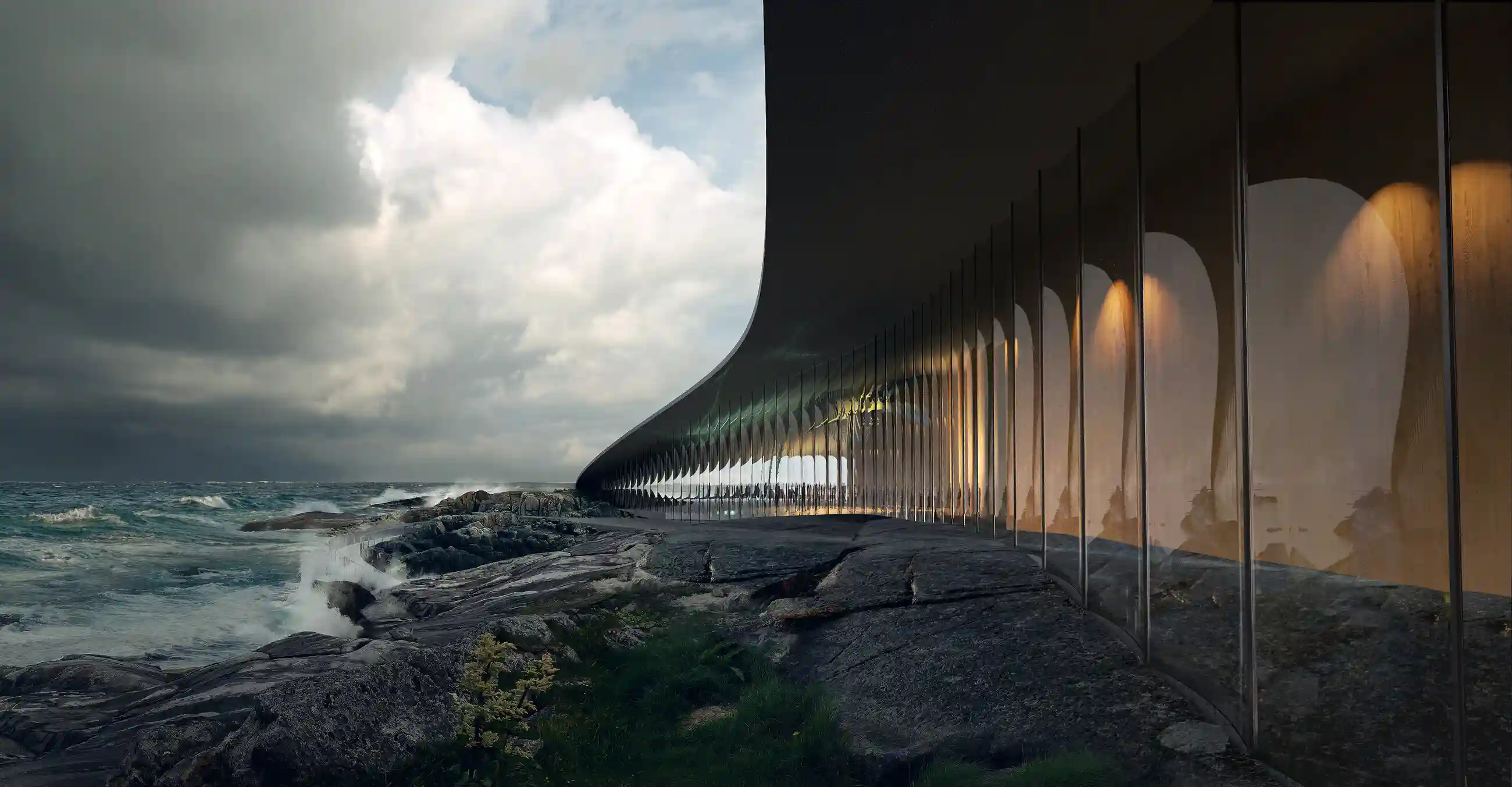
This deep fissure is no random seafloor formation; it is a colossal planetary engine. Through a phenomenon known as deep-water upwelling, it pulls freezing, nutrient-dense waters from the open ocean directly to the edge of the land. This biological motor draws some of the world's most mysterious creatures to these shores. In this dark, boundless valley—where the waters refuse to freeze even in the harshest winter months—lies an ancient feeding route for the sperm whales.
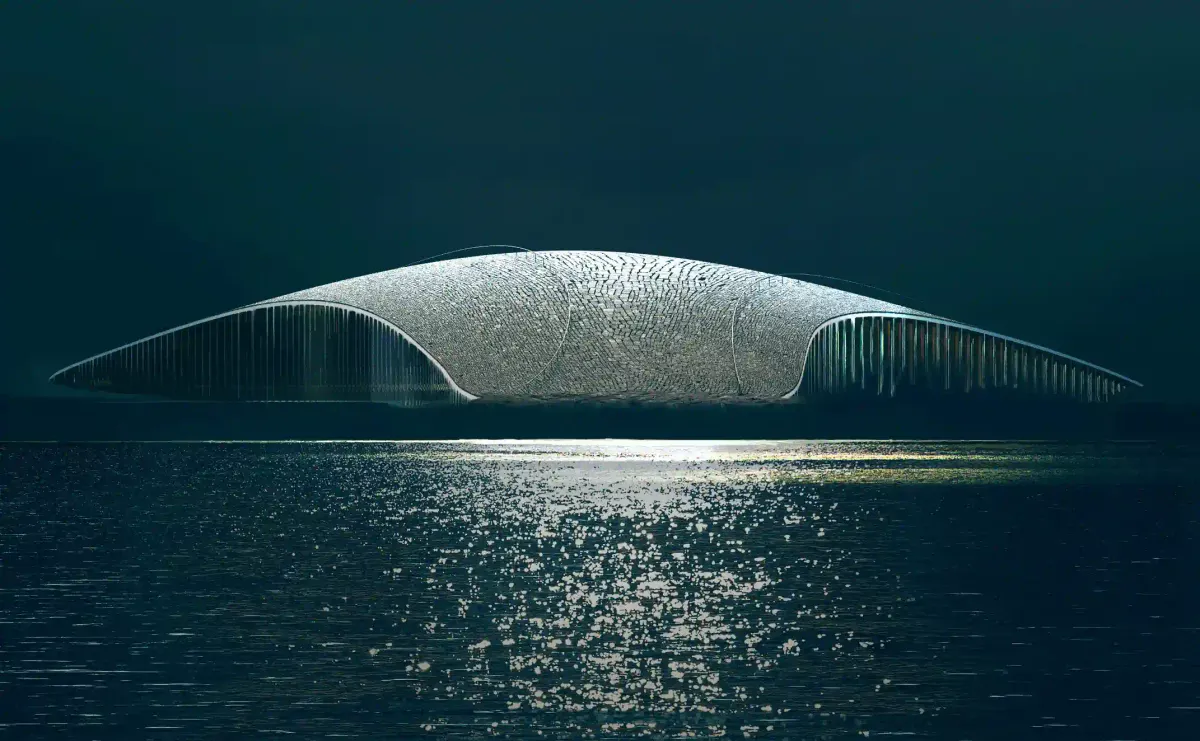
This is precisely why the foundation for "The Whale," a monumental project designed by Danish architecture firm Dorte Mandrup and scheduled to open in June 2027, is being laid on this specific, jagged coastline. The building’s location was not chosen simply to offer humans a scenic tourist viewpoint; it was determined so that it could stand directly at the absolute epicenter of this ecological phenomenon, bridging the gap between human observers and the enigmatic world below.
Dissolving Borders: The Strategy of Invisibility
Opening such a magnificent ecosystem to tourism typically marks the beginning of the end for that region. Humanity tends to consume ecology by building massive observation towers, concrete hotels, or aquariums that reduce wildlife to a marketable spectacle. However, Dorte Mandrup’s architectural philosophy for The Whale completely rejects this anthropocentric approach.
"It rises naturally as a soft hill on the rocky shore as if a giant has lifted a thin layer of the crust of the earth and created a cavity underneath... Instead of creating borders, we are dissolving them."
— Dorte Mandrup A/S, Project Manifesto
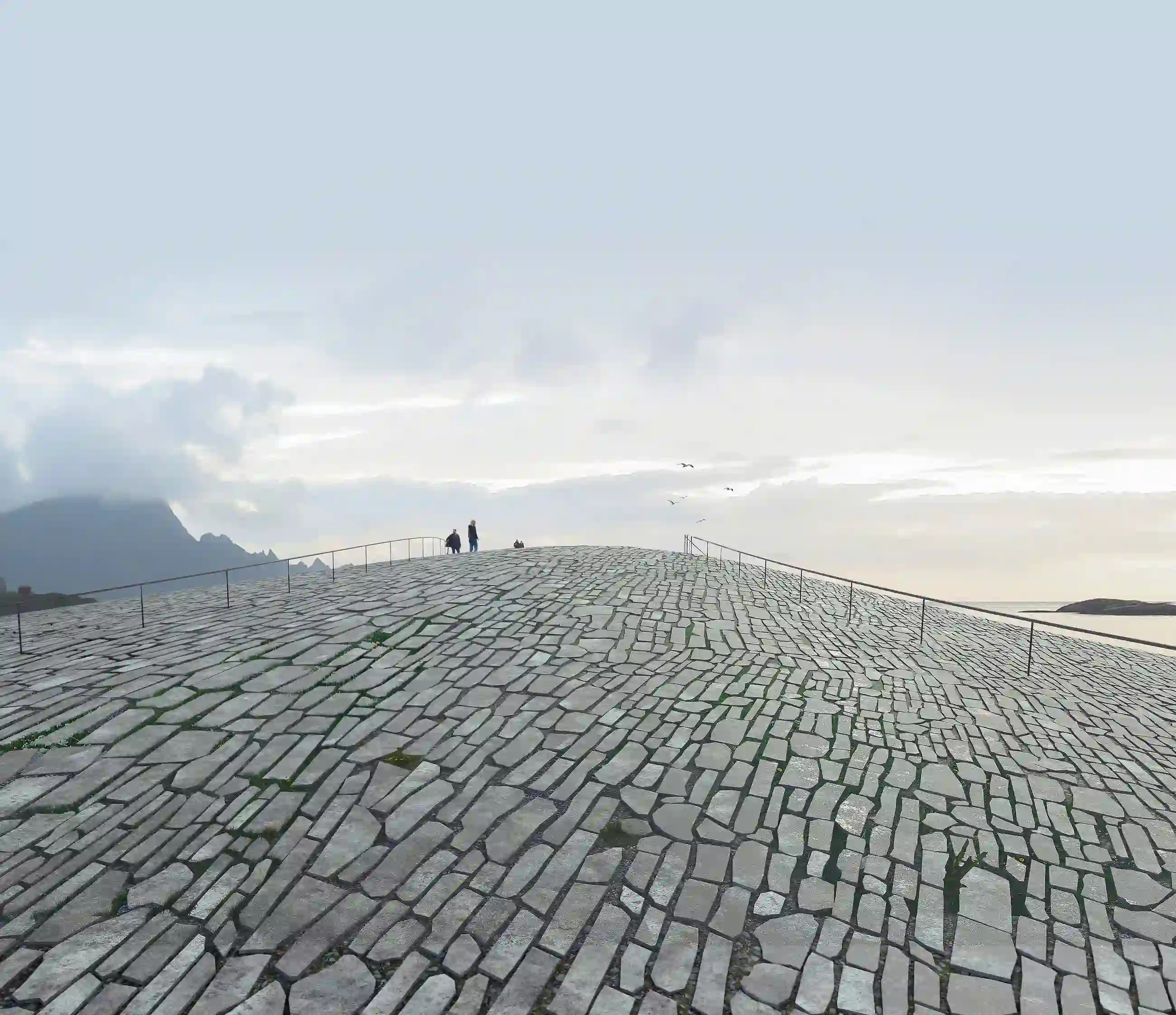
Far from acting as an intrusive mass superimposed onto the terrain, the structure aspires to become the landscape itself. Rather than defying or obstructing the fierce Arctic gales, the building’s aerodynamic form allows the wind to glide effortlessly over its surface, reducing snow accumulation to zero. Completely devoid of interior load-bearing columns, this colossal parabolic shell is elegantly clad in locally sourced slate and granite.
In modern architecture, it is generally desired that buildings remain as pristine as the day they were constructed. The Whale, conversely, is designed to age, weather, and surrender. The exterior stones are intentionally allowed to oxidize, erode by the wind, and gather moss. Within a few years, this walkable roof will be completely camouflaged among the gray Norwegian bedrock. In other words, the Arctic climate is expected to slowly swallow this human intervention, integrating the structure organically into nature without reducing it to a ruin.
The Scale Shock
The interior experience, curated by Ralph Appelbaum Associates, is designed to induce a profound physical scale shock—reminding humans of their true place in the face of the vast ocean. While the distinction between inside and outside is eradicated through boundless, massive glass facades, specialized acoustic chambers will allow visitors to step briefly into the whales' reality. Here, you will be able to feel the ancient frequencies and the heartbeat of a sperm whale—echoing from over a thousand meters below—reverberating directly within your own body.
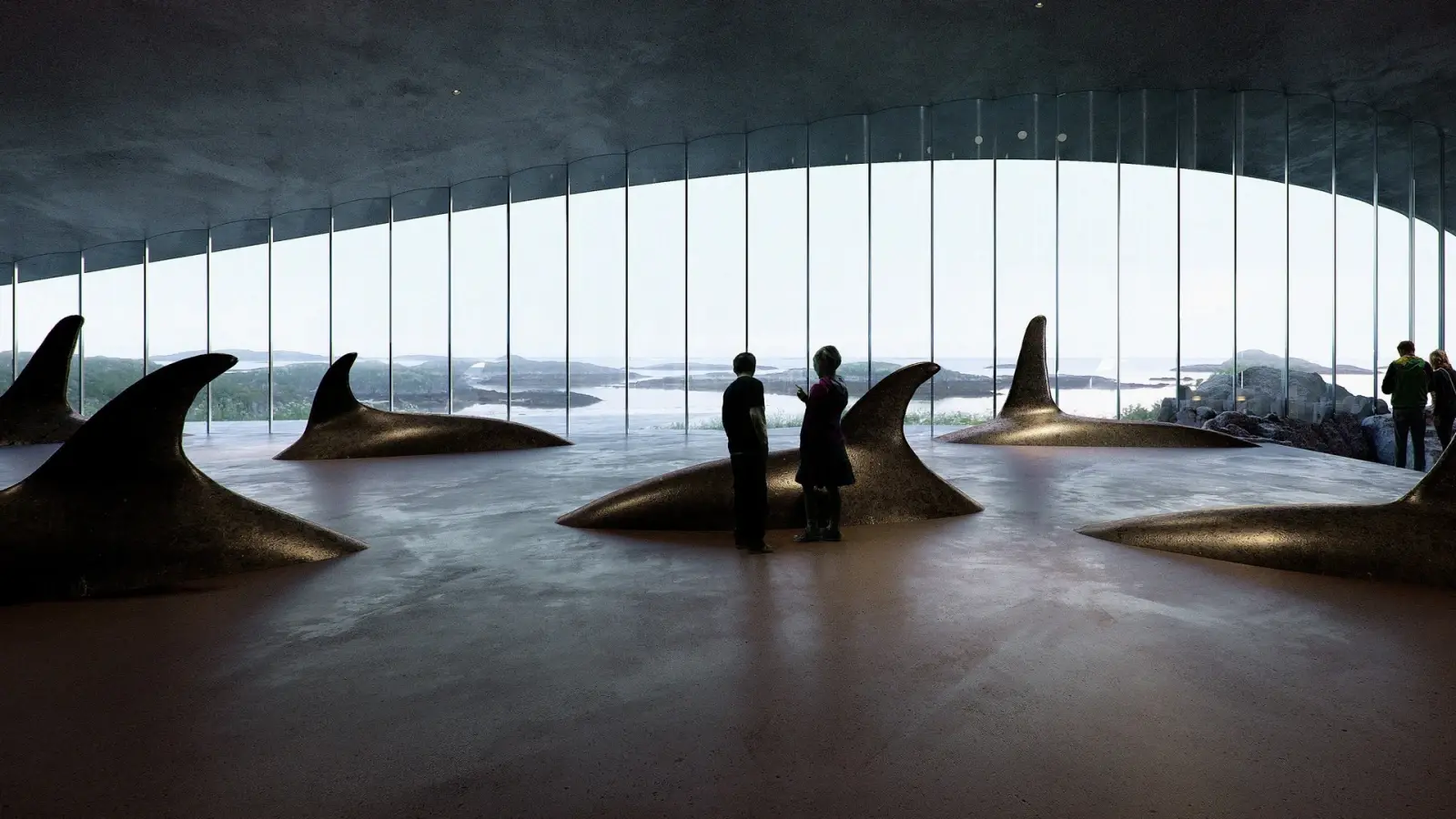
The reality that the seas, which humans have aggressively divided on maps, are but a single, immense universe to the whales will be imparted to visitors through this immersive sensory architecture.
The End of Human Hubris
For centuries, our modern hubris convinced us that the tools we invented and the cities we built exempted us from the rules of biology and the cycles of nature. Rather than seeking to understand the other intelligent societies with whom we share this planet, we chose to cage them in giant aquariums or reduce them to mere data points by tagging them with GPS trackers.
Yet, on this desolate Norwegian coast, a staggering role reversal is taking place. This time, instead of asserting dominance over nature, humanity is willingly stepping inside a stone shell, shrinking its borders, and choosing to sit in absolute silence.
We are finally learning that the greatest architectural triumph is not building a monument to conquer the landscape, but figuring out how to become invisible within it, waiting patiently for the ocean’s true masters to approach on their own terms. If our highest evolutionary achievement is finally learning to shrink before nature... were the colossal concrete empires we built all along not monuments to our power, but rather to our profound cosmic loneliness?
— Related Reading: The Pedagogy of Destruction: Why Does Japan Kill a Building to Keep It Alive?