The Pedagogy of Destruction: Why Does Japan Kill a Building to Keep It Alive?
Western preservation freezes history behind glass. But at Japan’s Ise Jingu, a 1,300-year-old shrine proves that sometimes, to keep a structure truly alive, you must intentionally kill it every two decades.
In the Western world, the concept of architectural and historical preservation is built on freezing material. The moment we decide a structure has historical value, we draw an invisible security cordon around it. We imprison weathering stones behind glass cases, coat wood in chemicals, and condemn the building to climate-controlled isolation. To us, history is a static relic meant only to be observed from a distance.
Yet the Ise Jingu shrine in Japan's Mie prefecture relies on a radical architectural philosophy that fundamentally rejects this paradigm of passive preservation.
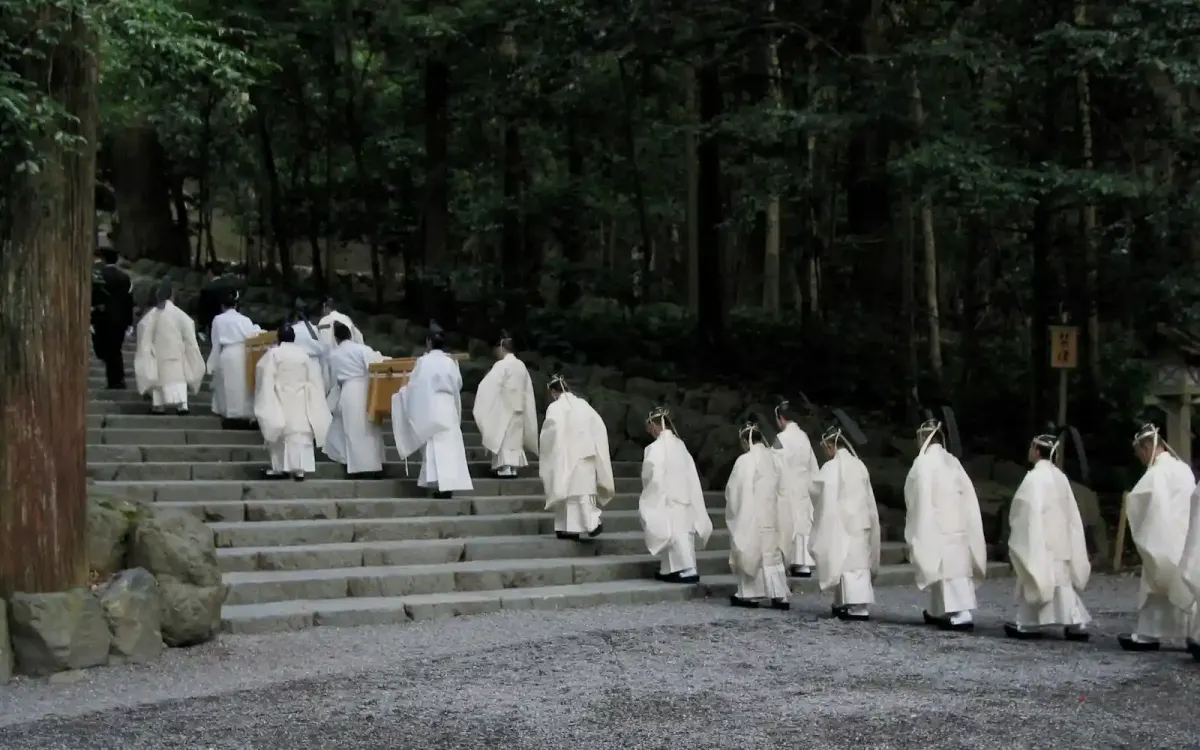
Ise Jingu boasts a history spanning over 1,300 years. However, if you visit today, not a single piece of wood you touch is older than twenty years. Through a ritual known as Shikinen Sengu, the shrine is dismantled down to its foundation every two decades. On an adjacent, identical plot that has lain empty for nineteen years, an exact replica is built from scratch. Once the sacred relics are transferred to their new home, the old shrine is completely dismantled, and the salvaged wood is distributed to repair other, smaller shrines across the country.
Preparations for the 63rd cycle of rebirth are currently underway; a process that will begin with the felling of the first trees in 2025 and conclude with the completion of the new shrine in 2033.
The 20-Year Biological Clock
At first glance, this ritual might seem like a colossal waste or a mere aesthetic obsession to the modern mind. "If you are going to build the exact same thing, why completely tear it down instead of repairing the old one?" The Japanese cypress (hinoki) used in the construction can easily withstand centuries if properly maintained.
The true breaking point here is that the "20-year" limit stems not from a structural necessity, but entirely from a biological and pedagogical clock.
If you build a temple out of stone and allow it to stand for 200 years, the master craftsmen who built it will pass away. As long as the building stands, the ancient construction knowledge that brought it into existence is buried under the earth. Two centuries later, when the building eventually collapses, there will be no one left who knows how the timbers were interlocked without a single nail, or how that specific curvature was given to the roof. The knowledge is crushed to death under the lifespan of the building.
At Ise Jingu, what is truly preserved is not the physical building itself, but the act of building it—the knowledge itself.
Twenty years is the precise transmission window within a human lifespan. A 20-year-old apprentice does the groundwork and gets to know the wood during their first cycle. By age 40, they assume primary responsibility for the structure as a master carpenter (miyadaiku). When they reach 60, they become an overseer, watching from the sidelines and passing their knowledge down to the new 20-year-old apprentices.
As magnificent as this biological transmission chain is, it is equally fragile. In fact, during the chaos of the Sengoku (Warring States) period that erupted in the 15th century, this cycle was interrupted for over 120 years. When the ritual was finally revived in the late 16th century, the master-apprentice chain had long been broken. The knowledge of how to build the structures had to be meticulously scraped together and reconstructed from inadequate written records and the fragmented memories of elderly craftsmen. This historical trauma bitterly proved why the 20-year cycle is vital: When the human biological memory chain breaks, the building doesn't just collapse; it truly dies.
The Ship of Theseus and Eternal Youth

One of the most famous thought experiments of ancient Greek philosophy, The Ship of Theseus, asks whether a ship remains the same ship if all its rotting wooden parts are gradually replaced with new ones. Western epistemology has stumbled before this problem of identity and material for millennia, because for the West, identity relies on the physical parts remaining original.
Ise Jingu, however, solved this paradox centuries ago. According to Shinto philosophy, permanence (Tokowaka - eternal youth) is achieved not by freezing matter, but through the continuous reproduction of form. The wood changes, the thatch covering the roof changes, the hands that build the structure change; yet the shrine remains the exact same shrine. Because even though the architectural "hardware" dies, the "software" that produced it has been successfully copied into the human nervous system, its breath, and its culture. Knowledge is not preserved on hard drives, in dusty archives, or behind museum display cases; it is safeguarded within the human body as a living, sweating, and working practice of civilization.
In our modern lives, to "protect" the statuses we have acquired, the relationships we have built, and the identities we have constructed, we often close them off to change, turning them into static museums. These structures, around which we build invisible glass cases out of the fear of losing them, may look solid from the outside, but inside, they slowly run out of breath and rot.
So, that most solid identity of yours today, the one you tightly cling to and freeze in the name of protecting it, declaring "this must never change"; could it actually just be a ruin preserved from rotting on the outside, but already breathless on the inside?
— Related Reading: Why Japan Protects Sunlight by Law