How 350 Birdhouses Forged a Peace Treaty Between Architecture and the Taiga
Suspended in the Harads forest of Swedish Lapland, Treehotel's Biosphere features a facade of 350 birdhouses. Far from a mere aesthetic choice, BIG’s design is a calculated response to industrial forestry: an architectural peace treaty forcing humans to surrender dominance over the wild.
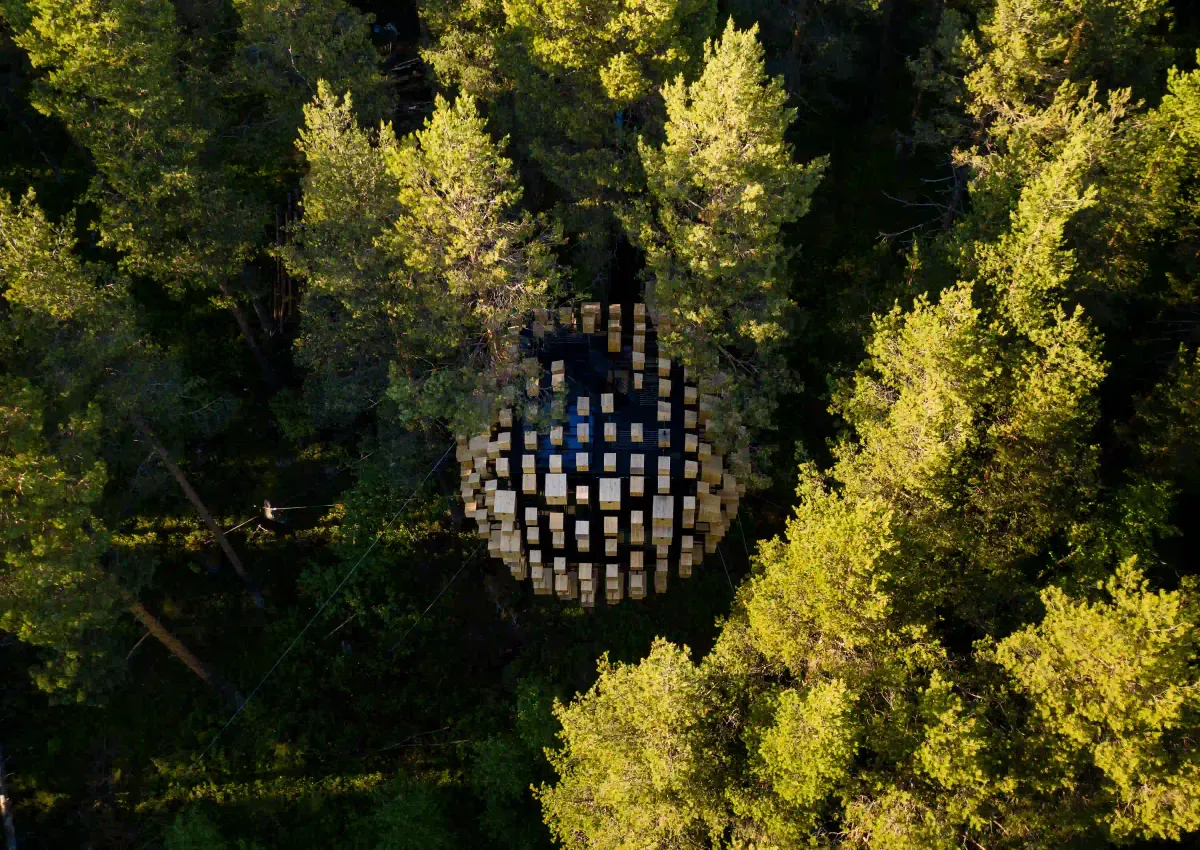
Located in the Swedish village of Harads as part of the Treehotel, Biosphere is a 34-square-meter cubic ecological hotel room designed by Bjarke Ingels Group (BIG) in 2022, its facade enveloped entirely by 350 wooden birdhouses. Yet, beyond this fundamental architectural definition, a much starker reality frames the vast pine and spruce forests stretching endlessly along the drive from the Luleå airport toward Harads. Lined up at precise intervals, rising to the exact same height and age, these trees offer the untrained eye an illusion of untouched wilderness. In reality, the landscape before us is a colossal industrial plantation largely stripped of its biological diversity.
Ever since the modern forestry industry encoded the forest not as a living, breathing, and communicating complex organism, but as a timber reserve waiting to be harvested, the Swedish taiga has become the epicenter of a silent ecological contraction. Suspended in the midst of this illusion, Biosphere stands as the most tangible embodiment of architecture's attempt to reconnect with nature: a silent peace treaty signed between human-centric design and the ecosystem. From the most primitive cave shelter to the most ostentatious glass skyscraper, traditional architecture has been driven by a single, fundamental urge: to protect humans from external elements and establish a controlled boundary against the wild.
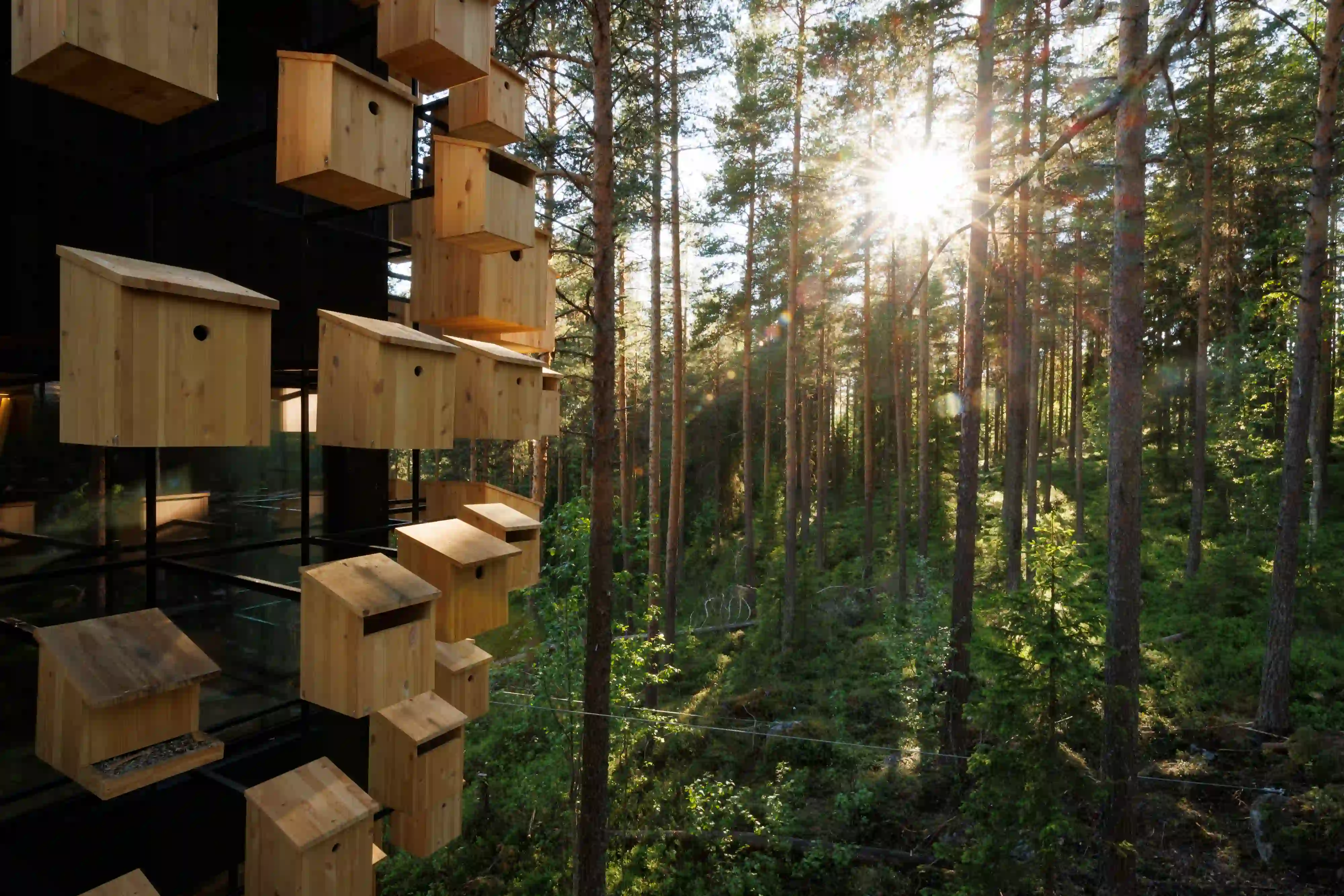
Biosphere sets out to completely subvert this entrenched hierarchy. The exterior of the cubic glass room suspended in the air abandons decorative wooden cladding in favor of artificial nests, manufactured to precise ornithological dimensions to shelter the region's bird and bat populations. Within this structure, guests are relegated to passive observers inside a load-bearing scaffold serving the avian colony that blankets the facade. This shift in hierarchy comes at a premium: the room opened at 12,000 SEK a night and now ranges between 14,800 and 17,200 Swedish kronor (approximately $1,400 to $1,650) depending on the season.
Silviculture and Chronological Shift: The Two Fronts of Collapse
The element that elevates the Biosphere project from luxury ecotourism marketing to the subject of profound editorial analysis is its uncompromising scientific foundation. Rather than relying on the aesthetic whims of Danish architects, the project was shaped by the stark field data of Ulf Öhman, chairman of the Norrbotten Ornithological Association. The traditional cycle of logging and replanting that has persisted in Swedish forests for centuries, industrial monoculture forestry, prevents the forest from aging, rotting, and forming natural hollows in tree trunks. The loss of these cavities has effectively wiped out the breeding grounds of species that specifically nest in them, such as the Western jackdaw and the common redstart.
This ecological crisis extends far beyond spatial constriction; it carries a devastating chronological weight. Climate change has triggered a fatal synchronization failure in biology known as a phenological mismatch. The unseasonably warm and early arrival of spring causes a premature boom in the insect population, the primary food source for hatchlings. Because the avian breeding cycle is tied more closely to daylight hours than temperature, by the time the eggs finally hatch, the insect swarm has already dissipated, disrupting the delicate, millennia-old clockwork of the ecosystem.
Ulf Öhman summarizes this ruthless biological reality and the necessary intervention in precise terms:
"Forestry has led to a reduced number of natural holes in trees where breeding bird nests. The installation of bird nests is therefore an important measure to take. Furthermore, climate change leads to the insect boom happening earlier in the year, and by the time the birds’ eggs hatch, the boom has already passed."
In light of this harsh data, the 350 nests on the exterior transcend photogenic appeal. They transform into an artificial respirator in architectural form, attempting to substitute the habitat that industry has ruthlessly eradicated.
From Ecological Response to Architectural Form
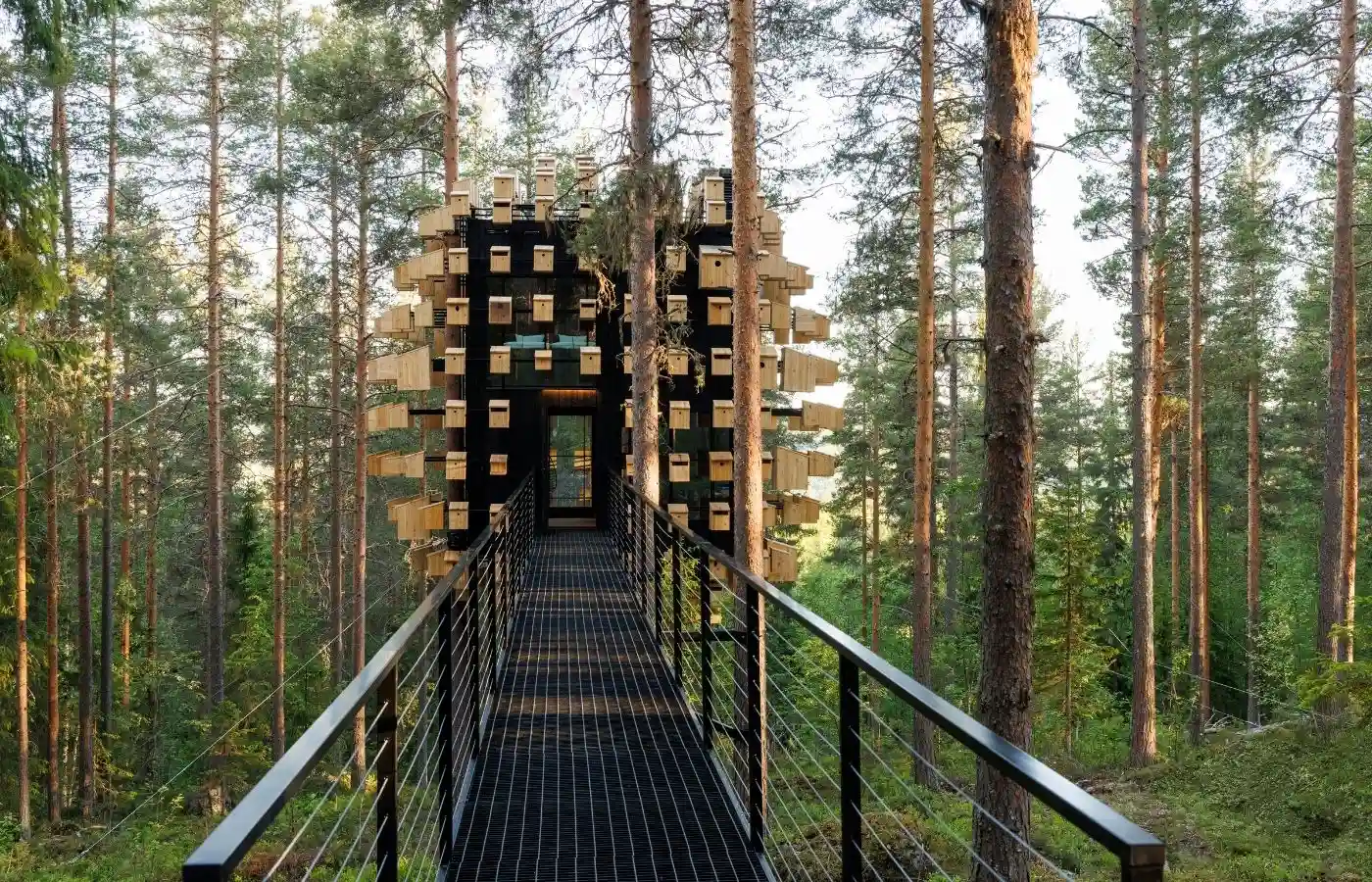
Bjarke Ingels Group’s design strategy surrenders the building's form not to human ego, but to the urgent needs of nature. Accessed via a suspended bridge that slopes gently from the forest floor up to the treetops, the outer layer of the cube is microscopically scaled to accommodate various members of the forest fauna. Ranging from millimeter-precise entrances for small chickadees to differently sized volumes designed exclusively for bats, each wooden nest expands outward to integrate with the biological rhythm of the forest.
The arrangement of the boxes on the facade using a solid-open (checkerboard) concept masterfully filters incoming natural light while dissolving the harsh, geometric lines of the structure when viewed from the outside. This strategy transforms the building into a massive, organic forest cocoon. The triple-glazed facade insulates the guest inside from the freezing cold of Northern Sweden and the chaotic noise of hundreds of flapping wings, yet it never severs visual contact or that sense of transparency.
The restrained design, understated choice of organic materials, and dark color palette of the interior are curated to make the space forget its own existence, directing the human eye straight toward the wildlife. A darkened interior minimizes reflections on the glass, a crucial architectural intervention designed to prevent fatal bird collisions. Stepping onto the roof reveals a terrace that commands a 360-degree view of the forest, placing the visitor perfectly in line with the tree canopies.
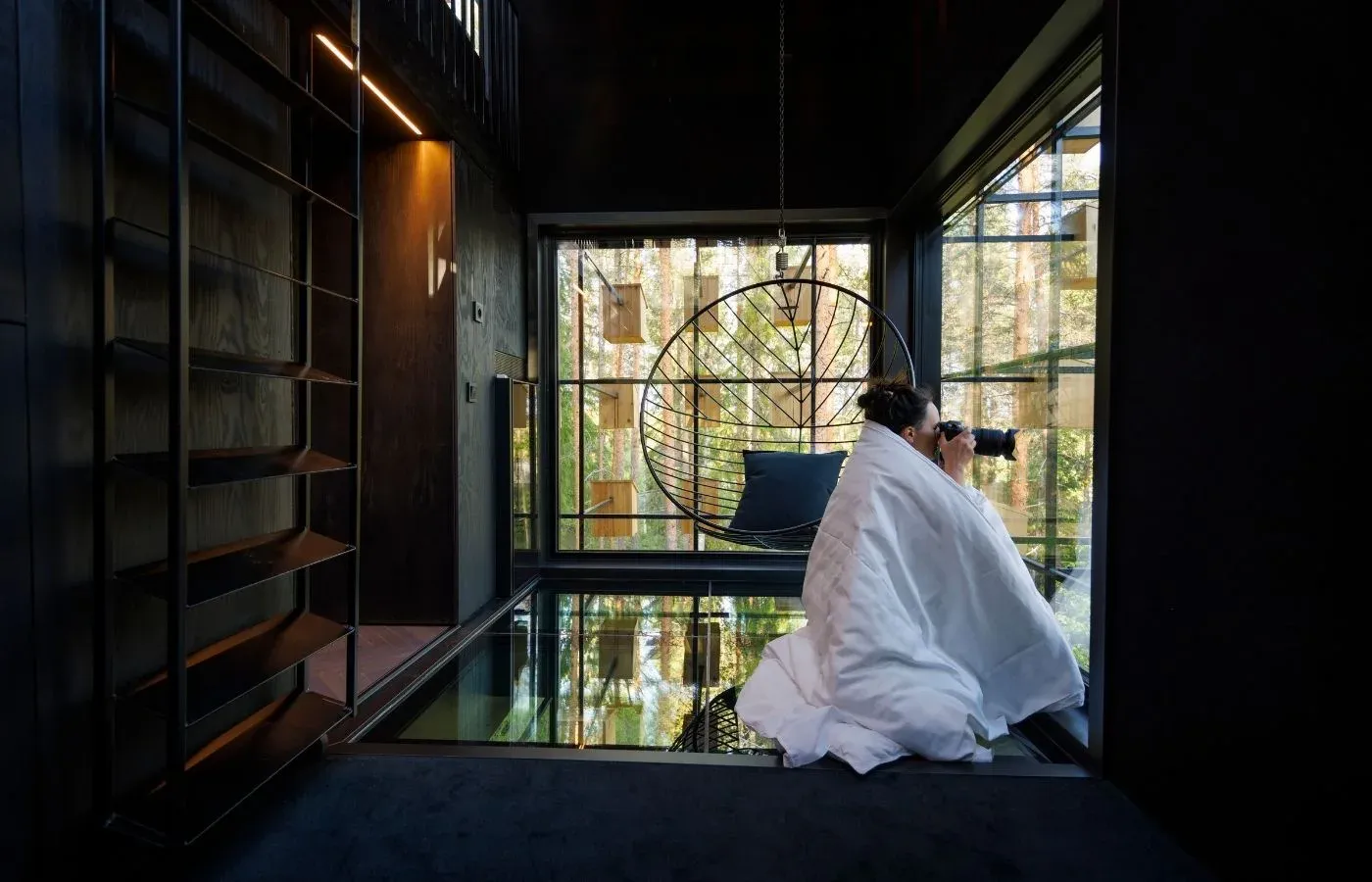
João Albuquerque, one of the partners at BIG, defines the philosophy behind the design through the structure's dialogue with the ecosystem:
"The ecological response is the driver behind the architectural expression, helping to create a positive environmental impact."
The "ecological response" Albuquerque points to signifies architecture abandoning its desire for independence from the wild, choosing instead to submit to the rhythm of the surrounding habitat.
A Pedagogical Prototype or the Ecological Laundering of Luxury?
Can a 34-square-meter design marvel, costing nearly $1,600 a night, single-handedly halt the freefall of the bird population in the forests of Northern Sweden? Absolutely not. Considering the devastation wrought by the global climate crisis and hundreds of thousands of hectares of monoculture plantations, 350 wooden boxes on a hotel facade are merely a drop in the ocean. At this intersection of high-end hospitality and environmental crisis, Biosphere sits at the center of a contradictory debate: Is this structure merely a flawless object of luxury consumption designed to assuage the ecological guilt of wealthy travelers, or does it serve as a working pedagogical prototype for a radical new architectural ethic?
The answer lies in the paradigm shift it offers. Modern environmentalism often defines nature preservation as creating isolated reserve areas completely untouched by humans. Biosphere whispers a different possibility, that we can sustain our presence while simultaneously expanding the living space for other species. Striking details, such as the glass facade remaining clean because birds biologically avoid soiling their own nesting areas, prove that interspecies cohabitation can function seamlessly on an architectural plane.
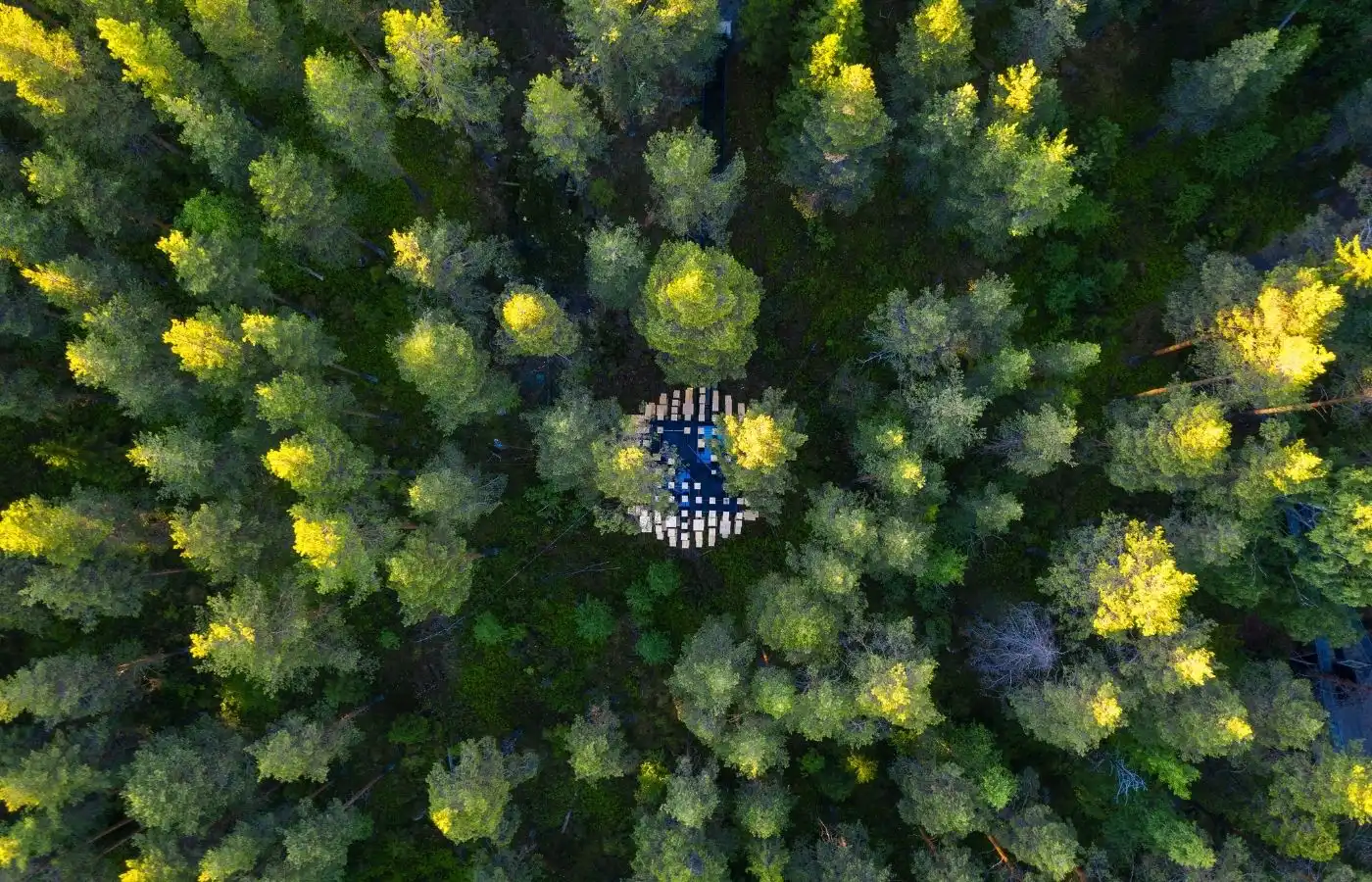
The true power of this design is hidden in the fracture it creates in the mind of the visitor who leaves that room, or the reader examining this project. A person looking at their own suburban home, their balcony in the middle of the city, or the blank facade of their office building can no longer view those surfaces merely as lifeless walls. Every architectural boundary is a potential biological niche, a void that can be transformed into a new home for wildlife.
When you step onto that 360-degree terrace at the top of the trees and look down upon the Lapland taiga, the sound of hundreds of wings humming beneath you serves as a reminder of one fundamental truth. The ultimate goal of architecture is not to dominate nature or isolate from it, but to dare to make room for other lives in every square centimeter of the boundaries we draw. The future of the planet depends on our courage to redefine every structure we build as a node connecting to the vast web of the ecosystem.
— Related Reading: The World’s Most Flawless Art Utopia: The Invisible Reality of Naoshima Island