The Ocean’s Darkest Secret: How a 40-Ton 'Whale Fall' Becomes a Century of Life
A life that begins in the sunlit photic zone doesn't end at death. The whale fall phenomenon proves that nature wastes nothing. From bone-eating Osedax worms to chemosynthetic bacteria, witness the four stages of how a fallen giant sustains an entire deep sea ecosystem in absolute darkness.
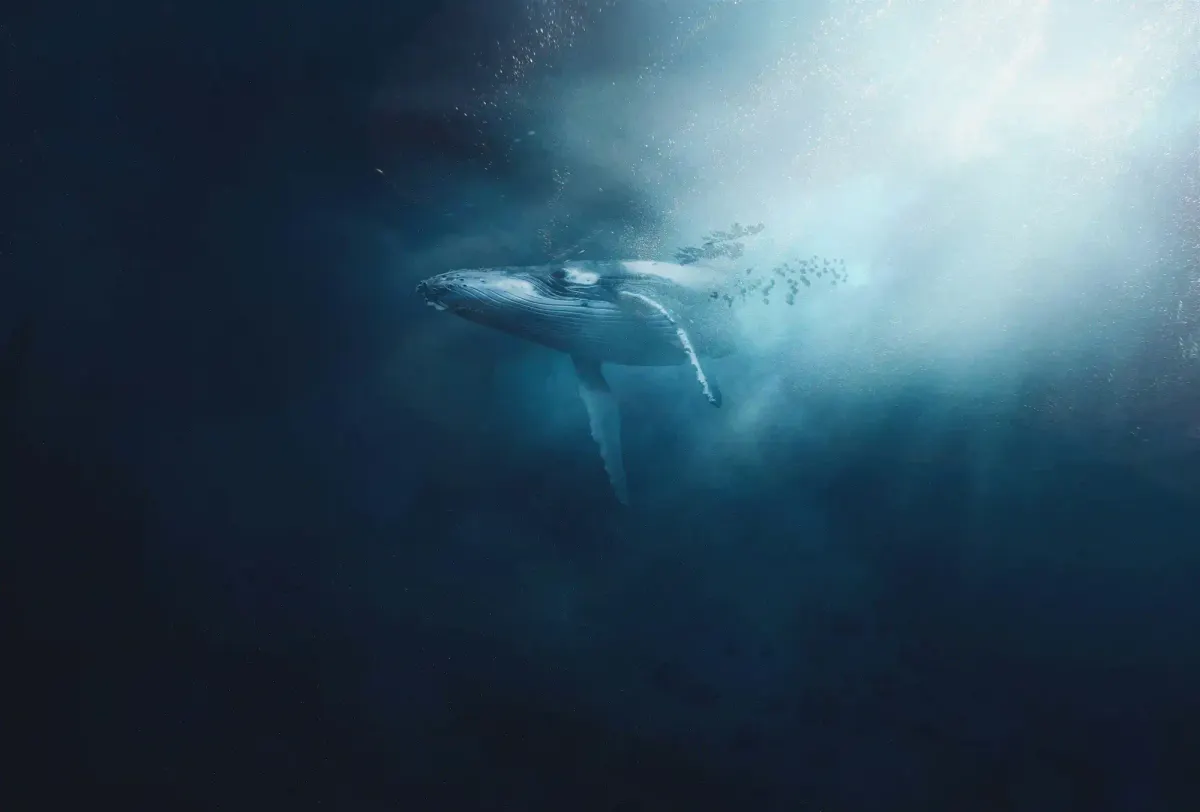
We are conditioned to accept death as an absolute end, a silent and final fade into nothingness. In most terrestrial ecosystems, the demise of an organism is little more than a quiet return to the soil. But thousands of meters beneath the ocean's surface, physics and biology dictate a far more staggering reality. When the body of a 40-ton whale takes its final breath and sinks into the pitch-black waters, this massive collapse is not the construction of a grave; it is the big bang of an entirely new biological galaxy.
At depths beyond 600 feet, photosynthesis is impossible, yet an astonishing 98 percent of marine life resides on or near the seafloor. Consequently, life on the abyssal plains relies heavily on "marine snow"—the microscopic organic debris and detritus that slowly drifts down from the surface over decades. In this crushing darkness, sustenance is the rarest currency. That is, until a colossal mass surrenders to gravity and plummets to the bottom. A single 40-ton whale carcass delivers the equivalent of 2,000 years of marine snow to a 50-square-meter patch of the seafloor in a matter of seconds. This extraordinary phenomenon, known in the scientific literature as a whale fall, shatters the deep sea's ruthless rule of scarcity with a single blow.
A Flawless Biological Choreography: The Four-Stage Feast
A whale fall is not a fleeting feeding frenzy; it is a calculated ecological composition that can span decades, even a century. When a carcass touches the seafloor, it triggers a meticulous metamorphosis, spanning from the macroscopic to the microscopic, which scientists divide into four distinct stages:
1. Mobile Scavenger Stage: In the first few months to a year and a half following the fall, deep-sea sharks, hagfish, and giant crustaceans—following the scent trail from hundreds of miles away—descend upon the carcass. Consuming up to 40 to 60 kilograms of flesh a day, they strip the soft tissue from the bones with terrifying speed.
2. Enrichment-Opportunist Stage: Lasting up to two years, this phase begins as decaying scraps of meat mix with the surrounding sediment. The area is quickly colonized by opportunistic crustaceans, polychaete worms, and other small benthic organisms. Up to 4,183 individuals can crowd into a single square meter, forming a writhing carpet of life around the remains.
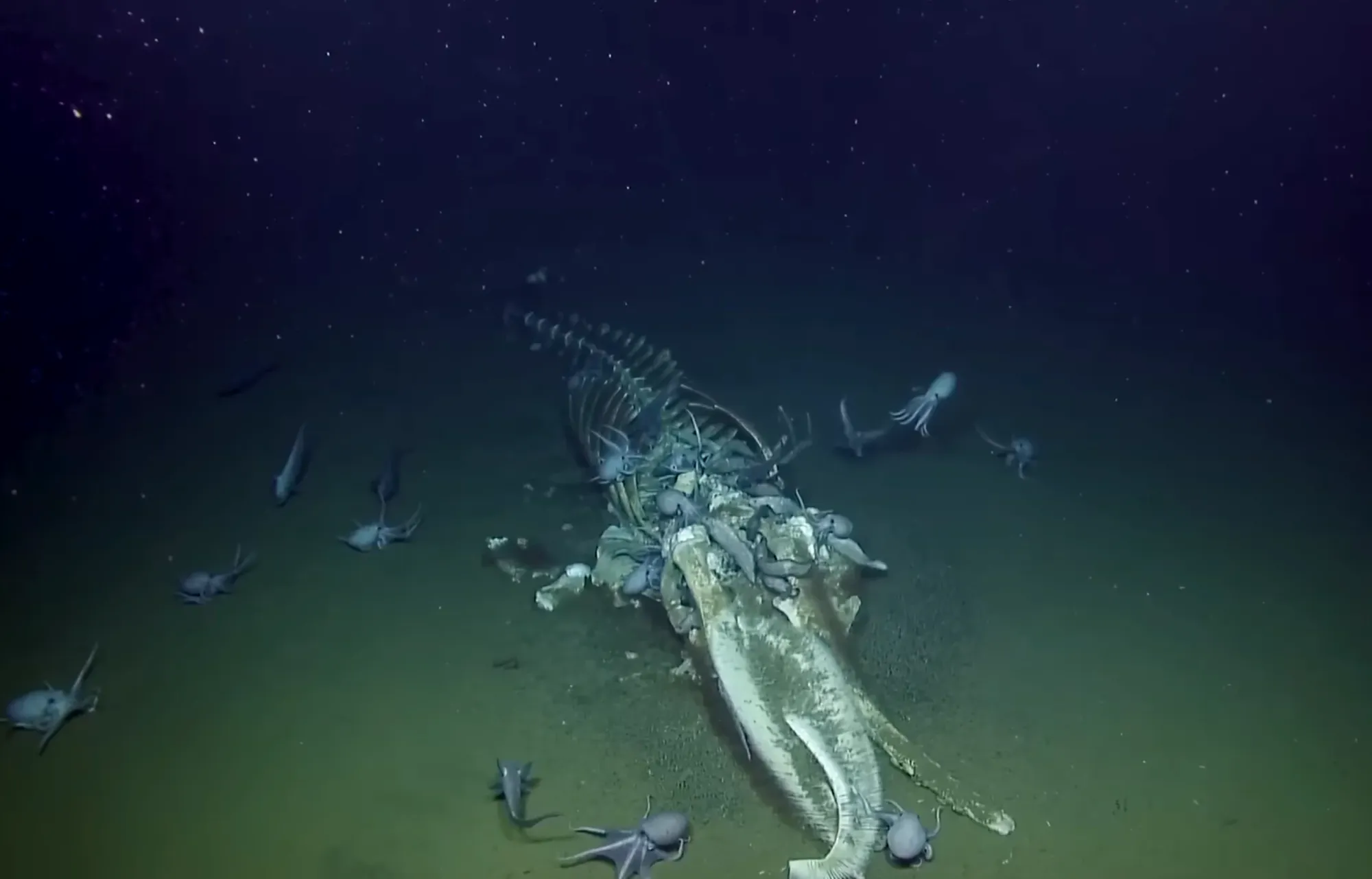
3. Sulfophilic Stage: Nature's true biological engineering begins when nothing is left but a colossal, bare skeleton. This stage can last anywhere from 50 to 100 years. The whale's massive bones serve as a hidden reservoir of lipids. Anaerobic bacteria break down these fats, producing toxic hydrogen sulfide gas. This lethal environment attracts the most bizarre creatures of the deep: the alien-like, mouthless, and eyeless Osedax (bone-eating) worms. Joined by chemosynthetic organisms living in symbiosis with sulfur-oxidizing bacteria, the lifeless skeleton transforms into a glowing, breathing reef that sustains up to 12,500 different organisms across more than 40 species.
4. Reef Stage: Once the lipids in the bones are entirely depleted, the carcass becomes a lifeless, mineralized structure. At this point, suspension feeders—organisms that filter particles suspended in the water—inhabit what remains of the bones, bringing the cycle to a quiet close.
The Diamantina Zone: A 5.3-Million-Year-Old Evolutionary Highway
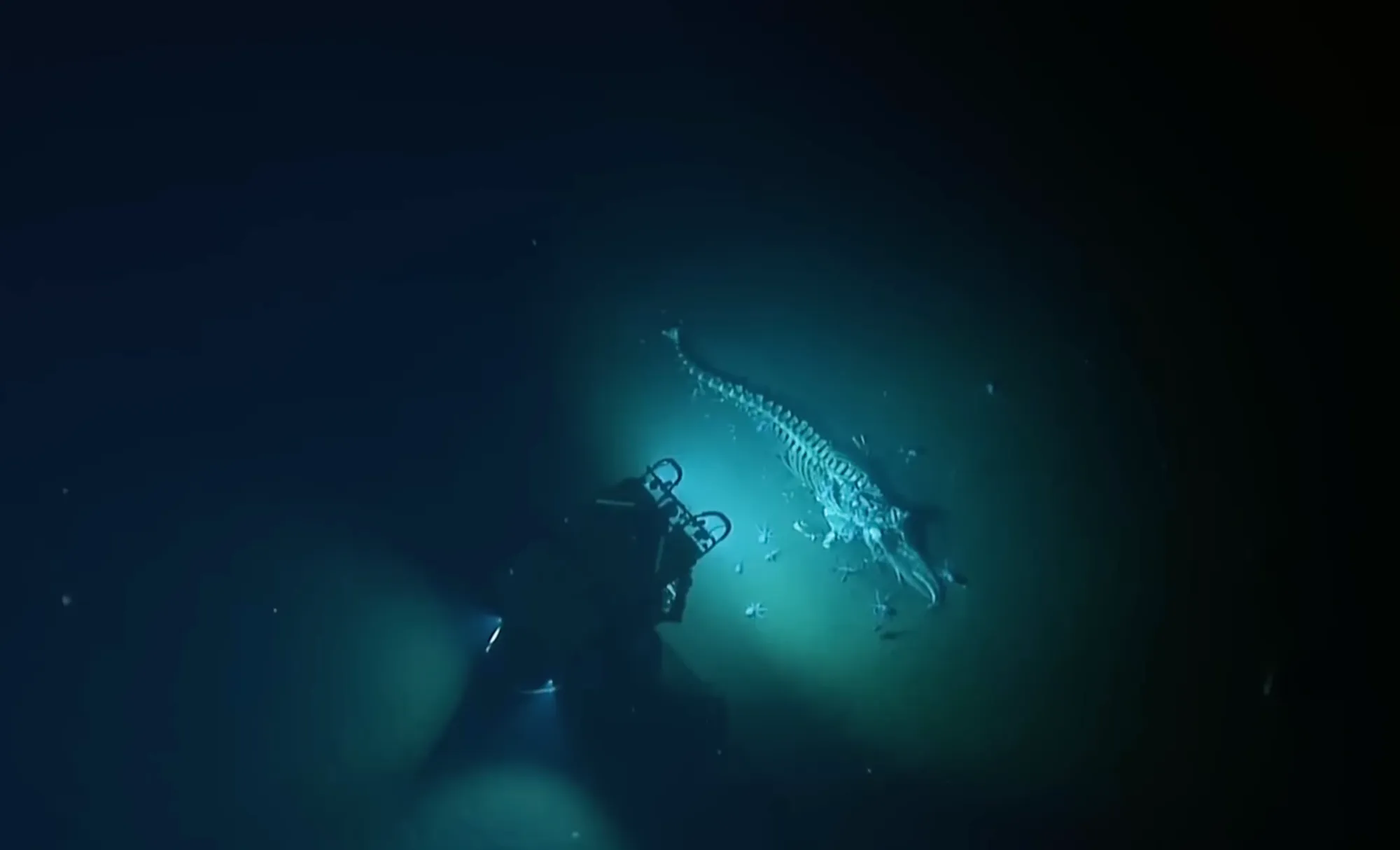
For centuries, the scientific community viewed whale falls as completely random, isolated feeding events scattered across the ocean floor. That assumption held until 2023, when the manned submersible Fendouzhe made a groundbreaking discovery in the Diamantina Zone, one of the deepest trenches in the Indian Ocean.
Between 4,616 and 7,001 meters beneath the surface, researchers mapped a massive "whale necropolis" stretching across 1,200 kilometers. Containing a total of 485 active whale falls and fossil sites, this area fundamentally disrupted our assumptions about evolutionary biology. Analyses using strontium isotope dating proved that some of these fossils date back 5.3 million years.
The vast majority of these skeletons belonged to beaked whales (Ziphiidae), a family renowned for their extreme deep-diving capabilities. But what was truly striking was that this massive necropolis was not merely a passive graveyard. For millions of years, the whale carcasses sinking along this exact route functioned as evolutionary "stepping stones" for chemosynthetic species. Osedax worms and deep-sea mussels utilized these skeletons like intermittent oases, crossing vast oceanic geographies they could otherwise never traverse, essentially financing their evolutionary migrations over epochs.
"Just as a dying star casts the building blocks of new planets into the void through a supernova, a falling whale scatters the elements of deep-sea life around it. Death is not an end, but a massive evolutionary seeding."
Death as a Biological Supernova
A whale fall offers not just a scientific revelation, but a profound philosophical confrontation. Human consciousness often perceives nature as a linear progression: birth, life, and death. Yet this biological banquet on the seafloor whispers that there are no straight lines in nature; everything is a flawless, unbroken circle.
The dismantling of a whale on the ocean floor is the biological equivalent of a cosmic supernova. When a massive star reaches the end of its life, it collapses inward and explodes, scattering carbon, iron, and oxygen across the universe—elements that later form the foundation of new planets and potential life. The alchemy of the deep ocean is exactly the same. When a whale dies, its energy is not lost; even the heaviest loss is dismantled with microscopic precision, reconstructed within the cells of chemosynthetic bacteria, and transformed into thousands of smaller, more complex consciousnesses. The ocean floor is not an abyss of endings, but an incubator where relentless beginnings are authored.
The Silent Threat: Expanding Oxygen-Free Deserts
Unfortunately, this flawless cycle, which has operated like clockwork for millions of years, is not immune to surface-level human hubris. While we may believe we have saved the ocean's giants through strict anti-whaling laws, a much more insidious and structural ecological threat is growing in the depths.
As oceans warm due to the global climate crisis, deep-water Oxygen Minimum Zones (OMZ) are expanding at a dramatic pace. Because warmer water holds less dissolved gas and ocean stratification is increasing, oxygen from the surface fails to reach the abyssal depths in sufficient quantities. The boundaries of hypoxia (low oxygen) are swallowing larger territories with each passing year.
The problem is that the worms, crabs, and chemosynthetic organisms that sustain a whale fall ecosystem require oxygen to survive. If the seafloor beneath global migration routes turns into an oxygen-starved desert due to climate change, the whales may continue to fall to the exact same coordinates, but the complex cities of organisms waiting to dismantle them and weave their massive energy back into the web of life will no longer be there. The invisible, millions-of-years-old highway of evolution will quietly shut down.
Nature is a flawless alchemist capable of turning the greatest of deaths into a century of life. But when we tinker with the Earth's thermostat and erase this deep oceanic memory with our own hands, nothing will remain of that hidden ecological highway but a rotting, toxic, and utterly silent pile of bones. Before we are left alone with our own tragedy, there is only one question we must ask: Are we truly prepared to pay the planetary price of halting this flawless architecture of life in the deepest corners of the ocean?
Watch: The 2019 Nautilus Expedition encounters a whale fall at 10,000 feet below the surface.
— Related Reading: How a One-Gram Brain Crosses an Ocean: The Collapse of the "One-Day Lifespan" Myth