The Breaking Point of Marble: What Strazza’s Transparent Veil Shows Us We Have Lost
How does cold, hard Carrara marble transform into a delicate, breathing veil? Giovanni Strazza's "The Veiled Virgin" offers an artistic illusion that defies the physical limits of stone.
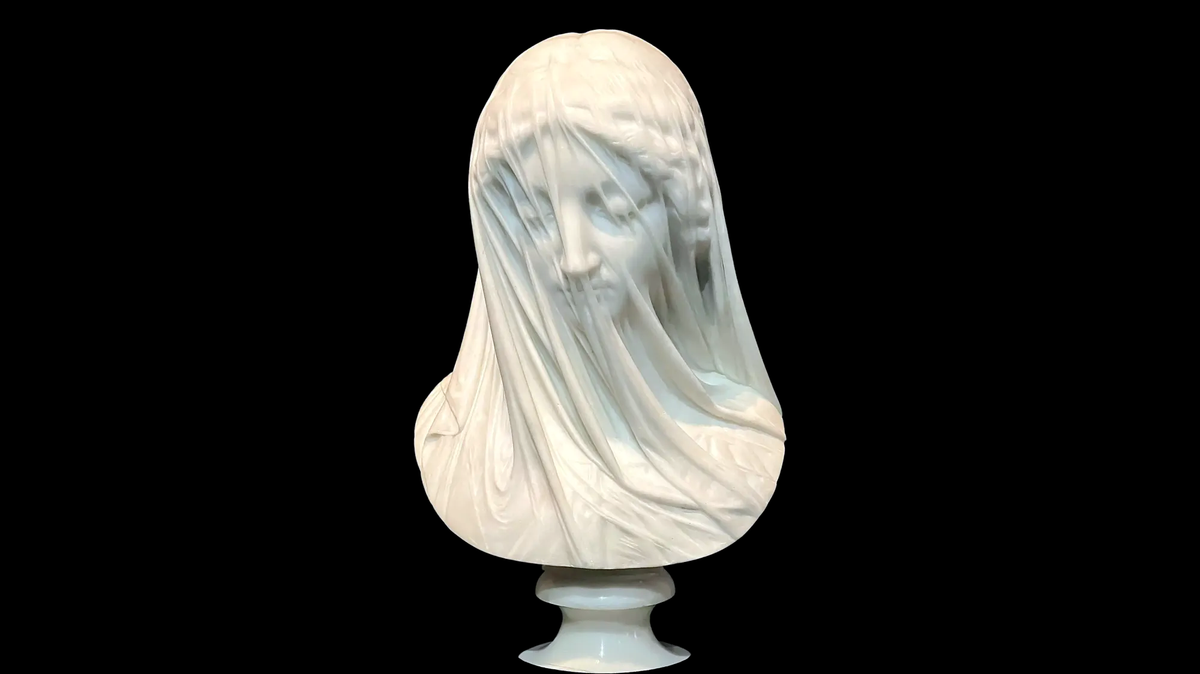
Looking at a block of stone and perceiving its weight, hardness, and uncompromising nature is one of the most fundamental reflexes of the human mind. By its very nature, stone is opaque; it conceals, hides, and resists. However, when delving into the anatomy of sculpture, we encounter an optical anomaly that demonstrates how the physical limits of a material can be bent by human will.
Created in the 1850s by the Italian sculptor Giovanni Strazza, The Veiled Virgin bust is a flawless example of this anomaly. When you stand before the piece, you do not see a solid mass of marble, but rather a damp, impossibly thin, and transparent fabric gently wrapping a human face. The closed eyes, the bridge of the nose, the curve of the lips, and the sorrowful expression can be read with millimeter precision beneath that hard rock. This is neither an optical illusion nor a visual trick; it is an irreversible, silent war waged directly against the molecular structure of the stone.
Carrara Marble's Trial by Light
The backbone behind Strazza’s creation of this impossible sense of transparency is a radical 19th-century reinterpretation of the "wet drapery" technique, whose origins trace back to the Hellenistic period of Ancient Greece. Yet, what elevates this technique from a mere "skill" to an "obsession" is the brutal risk factor inherent in the process.
This bust was carved not from ordinary stone, but from premium-quality Carrara marble extracted from the Tuscany region of Italy. The defining property of Carrara marble is its high concentration of calcite crystals. When light hits the surface of this marble, it does not bounce directly back; it penetrates the crystal structure, refracts within the stone, and emerges again. This physical reaction, known scientifically as "subsurface scattering," gives the marble a vibrant, warm glow closely resembling human skin.
However, Strazza's objective was not merely to create the texture of flesh, but to engineer the illusion of a "transparent fabric" draped over the stone. To achieve this, he had to thin the marble to the critical threshold that would maximize light transmittance without compromising its structural integrity. This is precisely where the breaking point that carries the artwork beyond time lies: as the stone’s thickness decreases, its translucency increases, but its fragility rises at the exact same rate.
Every strike of the chisel the sculptor took carried the risk of shattering that whisper-thin veil into pieces. In an era before modern machinery, carving the stone to the absolute edge of its breaking point meant that a single millimeter of miscalculation, an extra gram of pressure, or a hammer blow landing at the wrong angle had no remedy. The marble was unforgiving; months of labor could be reduced to a pile of rubble in seconds. Strazza completed this sculpture walking on the physical boundary of the material, under a constant threat of total destruction.
The Political Cryptography Behind the Transparent Veil
This flawless craftsmanship was not designed solely for the sculptor's ego or the exaltation of a religious figure. In 19th-century Italy, the "veiled woman" motif functioned as a piece of political cryptography.
Those were the years of the Risorgimento (Italian Unification) period, a time when Italy was struggling to transform from fragmented city-states into a single nation. This sorrowful, closed-eyed, and veiled face created by Strazza was, in fact, the embodiment of an Italy that had not yet achieved full independence—mourning, but waiting to awaken. The transparent veil covering the face is an allegory of national awakening, utilized to bypass heavy censorship. It is no coincidence that the artwork is both visually and conceptually an act of "concealing and revealing simultaneously."
A Triumph of the Chisel Across the Ocean
It would be the most logical deduction to assume that such a dense Italian national symbol and sculptural masterpiece is currently exhibited in a high-security museum in Rome, Milan, or Florence. However, the geographic destiny of historical artifacts is often unpredictable. For over 150 years, The Veiled Virgin has been quietly preserved thousands of miles away from Italy, at the Presentation Convent in St. John's, Newfoundland, Canada.
When the piece arrived in the city in 1856, brought from Italy by Bishop John Thomas Mullock, the local newspaper of the era, The Newfoundland Express, placed the bust in its headlines, describing it as "a triumph of the chisel to which ordinary language fails to do justice." Since that day, this block of marble has continued to showcase the limits of human will within the quiet walls of a convent across the ocean.
The Weight of Irreversibility
Looking back today, the marble that Strazza rendered transparent is not merely an anecdote of art history; it is also a severe critique of the modern relationship we have constructed with production and permanence.
Today, almost all of our actions—including architecture, design, and art—are built upon the concept of "reversibility." We can delete, copy, or render a text, a digital design, or a plan nonexistent in seconds with an "undo" command. In this frictionless production environment where the cost of a mistake has dropped to zero, we focus heavily on speed and results rather than the process itself.
Yet, what makes The Veiled Virgin a masterpiece is not simply the flawlessness of the final result, but the massive, irreversible risk embedded within its process.
The artwork was able to exist not because the possibility of error was completely eliminated, but because it balanced on a knife-edge where the price of an error was at its absolute highest. Every contact of the chisel with the stone was a permanent, inerasable decision.
While residing within that endless safety net where every action of yours can be reversed in seconds, mistakes can be effortlessly erased, and everything can be constantly rearranged; is it truly possible to believe that your actions carry a genuine weight and permanence that will transcend time?
— Related Reading: The Biological Cost of Beauty: Stendhal Syndrome