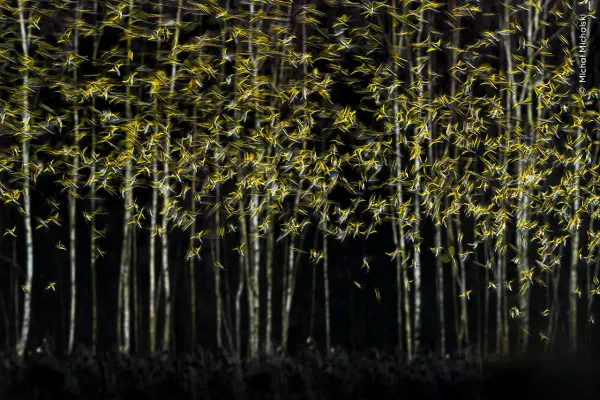
The Mathematics of Fear: Why Starlings Murmurate
For centuries, the hypnotic winter flights of starlings were thought to be telepathy. Today, science reveals a much darker reality. Behind one of nature’s most breathtaking visual displays lies a mathematical masterpiece built entirely on fear—a flawless algorithm fading from our skies.
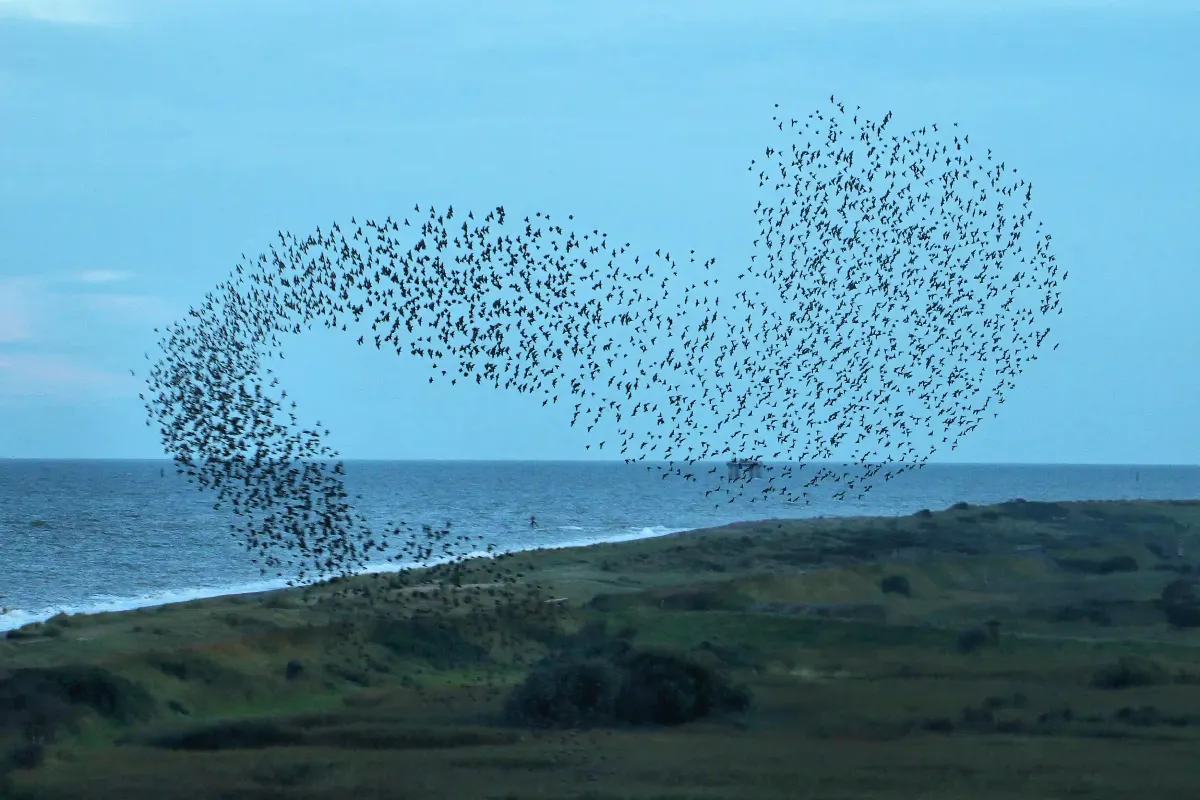
During the autumn and winter months, if you look to the skies over Europe and North America about an hour before sunset, you might witness one of nature’s most breathtaking visual spectacles. These massive black clouds of tens of thousands of European starlings (Sturnus vulgaris)—constantly shifting into spheres, planes, and waves—are known in the scientific community as a "murmuration." Named after the deep, resonant sound produced by thousands of wings beating in unison, the phenomenon looks from afar like a colossal calligraphy brushstroke across the sky or a ball of fire flickering in the wind. Yet, beyond this aesthetic illusion lies a ruthless and flawless algorithm for survival.
The Myth of Telepathy and the 'Rule of Seven'
For centuries, researchers were baffled by how tens of thousands of birds could fly at speeds of around 45 kilometers per hour without a single collision. This coordination was so inconceivable that in 1931, prominent ornithologist Edmund Selous described it as "a madness in the sky." To Selous, there was only one logical explanation for this complex behavior: telepathy.
"They must think collectively, all at the same time," he wrote.
Like many others, Selous assumed that complex behavior must stem from equally complex origins. However, groundbreaking observations made in 2005 by the married physicists Andrea Cavagna and Irene Giardina from the rooftop of the Palazzo Massimo in Rome revealed a truth far more striking than telepathy. Over three years of chilly evenings, the team used pairs of cameras to reconstruct the 3D positions of more than 4,000 birds in a single flock, proving that there is no overarching plan and no leader. Each starling in the flock interacts exclusively with its seven closest neighbors—a number researchers suggest might be the maximum capacity their brains can handle. The starlings do not keep track of these constantly changing alliances; they simply align their flight path with whichever seven birds are nearest, remaining close, but never too close.
Scale-Free Correlation: Where Physics Meets Biology
The birds do not need to engage in complex communication to navigate their massive trajectories. When Charlotte Hemelrijk of the University of Groningen in the Netherlands plugged just three simple rules—avoidance, alignment, and attraction—along with basic aerodynamics into a computer model, the resulting virtual murmuration perfectly matched the real-world data gathered in Rome.
Physicists explain this vast web of interaction through the concept of "scale-free correlation." When a starling turns, this new alignment influences its neighbors, who in turn influence theirs. Yet, unlike a children's game of telephone, this transfer of information does not degrade with errors; instead, the errors are entirely washed away in the movement. No matter how large the flock becomes, the information arrives at the furthest edge completely uncorrupted. Even though each bird only pays attention to seven neighbors, its senses effectively extend across the entire murmuration, allowing it to instantly react to a movement hundreds of birds away. The reason the flock looks like a single entity from the outside is that, physically, it truly behaves like one.
Target Degeneracy and the Architecture of Fear
Why do starlings expend such an immense amount of energy to constantly shift shape in the sky? For a long time, the scientific consensus leaned toward the "warmer together" hypothesis, assuming the displays served to advertise a roosting site and gather more birds for thermal benefits on cold nights. However, an analysis of over 3,000 murmurations across 23 countries, gathered through citizen science, revealed only a weak negative correlation between temperature and flock duration. The true determining factor was the "safer together" principle: defense against predators.
In approximately 30% of the recorded murmurations, birds of prey such as hawks, falcons, or harriers were present. As predators approached or actively engaged the flock, both the duration and the size of the murmuration increased. To study this predator-prey dynamic more closely, researchers have bypassed waiting months for a wild falcon attack by utilizing a robotic falcon ("fauxlcon") to map the flock's reactions. These studies show that starlings evade raptors through evasive maneuvers like a "flash expansion" scattering outward, or by suddenly forming a "vacuole" (a hollow space) in the center of the flock. This constant state of motion and shape-shifting creates what physicists call "target degeneracy," making it mathematically impossible for a predator to lock onto a single bird. The larger the group, the lower the risk of any single individual being hunted (the dilution effect). Furthermore, when predators are present, the birds are statistically far more likely to descend en masse to their roost rather than dispersing.
The Silent Extinction of a Flawless Algorithm
Millions of years of evolution have granted starlings this colossal collective intelligence, allowing them to outmaneuver even nature’s most apex aerial predators. Yet, the primary threat they face today comes not from the sky, but from human activity on the ground. While European starlings are omnivorous, they rely heavily on insect larvae, such as leatherjackets, that live in the soil beneath grasslands; as these grassy areas vanish, so does their food supply. Their habitats are rapidly shrinking due to urbanization and changing farming practices, such as moving livestock feed indoors.
In the UK alone, starling numbers have plummeted by 67% since the early 1970s, landing them on the red list for high conservation concern. While their Danish populations have dwindled by 60%, habitat loss and other human-driven causes have eradicated 550 million birds across Europe and 2.9 billion birds across North America within the same sixty-year timeframe. The pressures mounted by climate change and food scarcity are so severe that starlings have even been observed resorting to a rare survival strategy known as cooperative breeding, where fledged young help their parents feed the next generation of chicks.
Documenting this silent vanishing, Danish photographer Søren Solkær encapsulates the weight of what is being lost:
"When witnessing a starling murmuration, the external phenomenon seems to mirror something inside myself, illuminating the universal bond we have with nature."
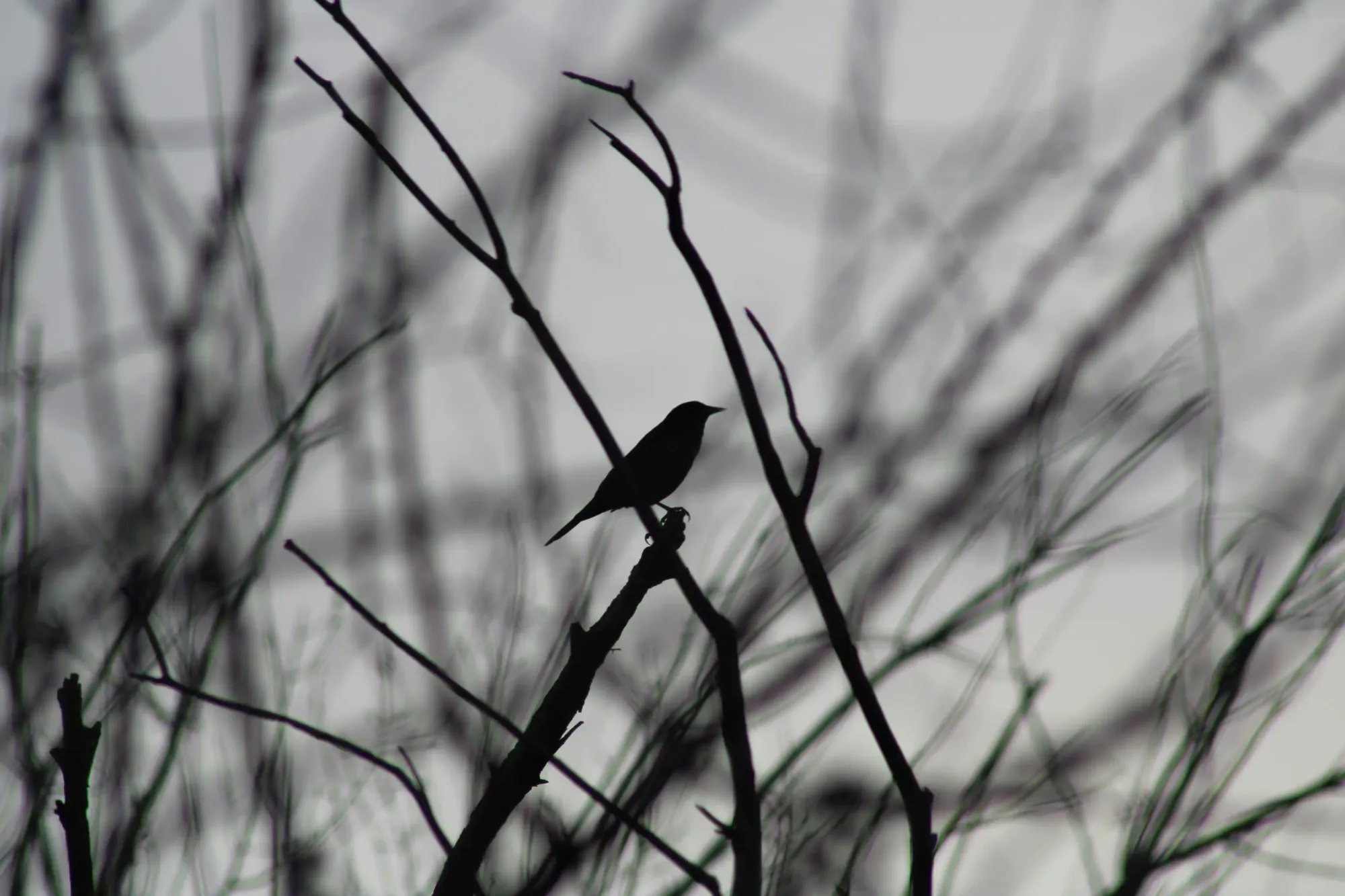
For a species to merely exist within an ecosystem, narrowly avoiding physical extinction, does not mean it has truly been saved. Earth’s most beautiful phenomena only emerge when living things can act together in great, thriving numbers. You can evolve a flawless biological algorithm based on scale-free correlation to outwit nature’s most ruthless predators, but when your habitat is suddenly paved over with concrete, evolution affords you no time to design a new defense mechanism. The fact that we have finally decoded the mathematical secret of the starling murmuration just as we are on the verge of losing it forever remains one of the most haunting questions suspended in our skies—a stark reflection of modern human hubris and our destructive relationship with the planet.
— Related Reading: Why Do We Diminish the Cultural Memory of the Wild as Mere ‘Instinct'?