Navigating Australia by Melody: The Auditory Architecture of the Songlines
We rely on satellites and screens to navigate, but what if a map was woven entirely of soundwaves? Understanding Aboriginal Songlines reveals how First Nations people mapped the vast Australian continent for 80,000 years using only rhythm, memory, and the human voice.
Human memory is an eccentric archivist. We can effortlessly forget a phone number mere seconds after hearing it, or lose the thread of a conversation we had yesterday. Yet, when the opening chords of a song we haven’t heard in two decades play on the radio, we instantly recall not only the lyrics but the exact visceral emotions, the scent of the air, and the quality of light from the moment it first became embedded in our minds. The human brain struggles to retain sterile, isolated data, but it possesses a profound, almost biological devotion to music and rhythm.
Imagine harnessing this neurological vulnerability—this innate human bias for melody—and using it to memorize the topographic map of one of the most unforgiving, vast, and formidable continents on Earth.
For the First Nations peoples of Australia, whose cultures represent the oldest continuous living civilization on the planet—spanning over 80,000 years—this is not a theoretical thought experiment. It is a breathtaking architecture of survival. Known as the Songlines (or Dreaming Tracks), this phenomenon represents what is arguably the most sophisticated spatial memory network in human history. It is a system that mapped an entire continent not by relying on the eyes to read a piece of paper, but by trusting the ears, the memory, and the vocal cords.
The Topography of Rhythm

To truly grasp the concept of a Songline, we must tear the idea of a "map" away from parchment and pixels and suspend it in the air, woven entirely of soundwaves. A Songline is not a simple tribal chant, nor is it merely a mythological fairy tale told to pass the time around a fire. It is, quite literally, an auditory GPS.
According to Indigenous belief, during the Creation era known as the Dreaming (or Tjukurpa in the Western Desert languages), Ancestor Spirits—taking the forms of giant animals, creator beings, and the elements—wandered across the formless earth. As they moved, they brought the world into existence, shaping waterholes, riverbends, and rocky outcrops.
Today, a Songline is the melodic footprint of that ancestral journey. When a traveler walks across the vast Australian outback, navigating terrain they may never have physically seen before, they sing the specific track of that route. The song acts as an incredibly precise geographic code. The ascents and descents of the melody are in flawless synchronization with the physical contour of the earth. If the notes suddenly accelerate and the rhythm sharpens, it signals an approaching steep, rocky ridge. A lingering, descending, and melancholic note might warn of a hidden, dried-out creek bed lying just ahead. The music literally describes the land.
A Continental Relay: The Seven Sisters
The sheer scale of these auditory maps pushes the absolute boundaries of modern comprehension. The most staggering example of this oral cartography is the epic of the Seven Sisters (Kungkarangkalpa).
It is deeply tempting for the Western mind to imagine a single, lone wanderer singing one uninterrupted song for thousands of miles. But the reality of the Songlines is far more complex and collaborative. The Seven Sisters track is not a single song owned by one person; it is a decentralized, open-source network of knowledge spanning an unfathomable 3,500 kilometers.

Beginning near Roebourne in Western Australia and stretching all the way to the eastern coast, the narrative follows the survival journey of seven sisters fleeing from a malevolent, shape-shifting spirit named Wati Nyiru (or Yurlu). Because Australia is home to hundreds of distinct First Nations, each with its own language and territorial boundaries, this epic story cannot be told by one group alone.
Instead, the map is carried like a baton in a massive, continental relay. As the Songline crosses three major deserts, it is held by the Martu, the Anangu, the Pitjantjatjara, the Yankunytjatjara, and the Ngaanyatjarra peoples. When a traveler from the west enters the territory of a neighboring nation in the east, they might not speak a single word of the local dialect. However, because the physical shape of the earth remains the same, the underlying rhythm of the song remains a constant. The traveler recognizes the melody.
The song acts as a universal cultural passport. By understanding the rhythm being sung by the local custodians, the traveler immediately knows where they are in the grand 3,500-kilometer narrative. It informs them which waterholes are safe, which foods are permissible, and which sacred sites are strictly off-limits. It is a biological contract of sharing a continent—not through conquest, but through listening.
A Dual Map of Earth and Sky
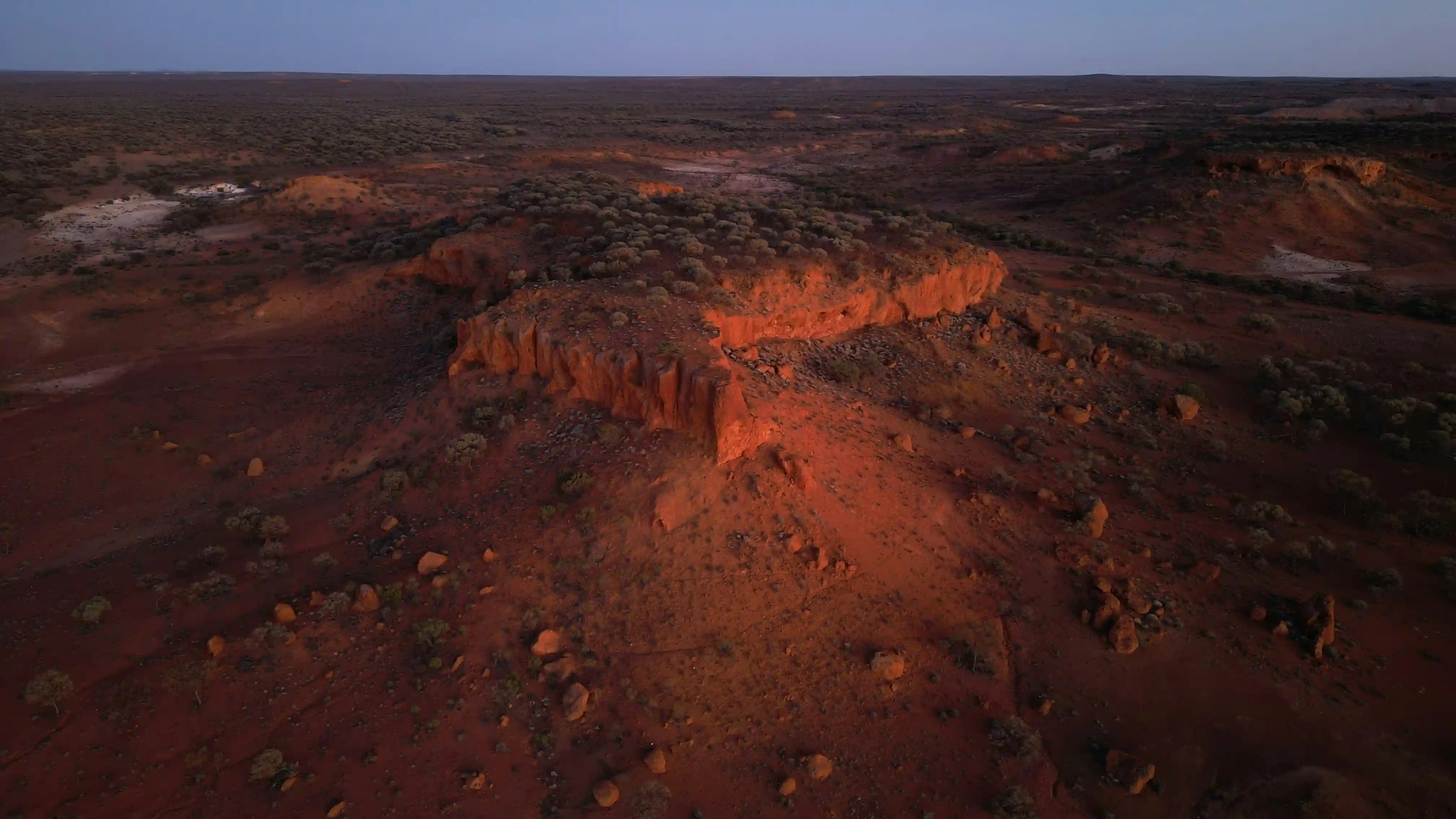
The genius of the Songlines does not end at the horizon. The most breathtaking aspect of this ancient system is that it does not only map the earth; it is simultaneously a map of the cosmos.
At a certain point in the Seven Sisters narrative, the earthly pursuit becomes so desperate that the women leap into the night sky to escape. There, they transform into the Pleiades star cluster. Their relentless hunter follows them into the heavens, becoming the constellation we know as Orion, doomed to chase them across the cosmic expanse for eternity.
A traveler singing this song is executing an act of staggering intellectual simultaneity. They are reading the map of the red dirt beneath their feet and the galaxy rotating above their head at the exact same time. Heaven and earth are locked together within a single, unbroken melody.
Architecture Grown in the Mind
Today, we outsource our spatial awareness to satellites orbiting in the exosphere. We have surrendered our sense of direction, our memory, and our perception of space to external machines. To remember a place, we must look at a screen or save its digital coordinates. If an environment is not visually cataloged, we consider it lost.
The Songlines offer a quiet, humbling revelation about the true capacity of human intelligence. History, in the Indigenous worldview, is not a linear timeline filed away in dusty books. It is alive, vibrating in the rocks, the soil, and the feet of those who walk it. As Nganyinytja, a revered Pitjantjatjara elder, so powerfully explained:
"We have no books, our history was not written by people with pen and paper. It is in the land, the footprints of our Creation Ancestors are on the rocks... We learned from our grandmothers and grandfathers as they showed us these sacred sites, told us the stories, sang and danced with us the Tjukurpa. We remember it all; in our minds, our bodies and feet as we dance the stories."
Imagine carrying the sheer incline of a mountain, the chill of a hidden waterhole, and the exact alignment of ancient stars entirely within your own vocal cords and muscle memory. Instead of claiming ownership of the world by drawing borders upon it, you transform the world into a song and let it live inside you.
If the map is not a fragile piece of paper, but a melody echoing in your consciousness—as long as you still have your voice, is it truly possible to ever be lost on this planet?
— Related Reading: Jane Goodall's Famous Last Words: Why Does an 'Intelligent' Species Destroy Its Only Home?