The Fairy Rings That Have Been Growing for Centuries
In 1675, natural philosophers suspected lightning. Folklore pointed to dancing fairies. Today, science traces these strange circles to fungi beneath the grass, where some colonies have been growing for centuries. One ring in Wyoming is estimated to be 522 years old.
In 1675, natural philosophers in England were trying to explain the strange circles appearing in meadows. Some were marked by grass noticeably greener than its surroundings. Others were bordered by mushrooms. One theory circulating among members of the Royal Society attributed the formations to lightning strikes, which were thought to leave circular marks on the ground.
But these same circles had long occupied a place in English folklore. Known as the dancing grounds of fairies, they were considered dangerous to enter. According to some traditions, anyone who stepped inside risked falling under the fairies' spell. Elsewhere in Europe, the formations were associated with gatherings of witches. In France, they were known as ronds de sorcières; in Italy, cerchi delle streghe.
William Shakespeare also wrote of fairies leaving green circles in the grass by moonlight and of mushrooms appearing at midnight in The Tempest. Their striking geometry, appearing in familiar landscapes without an obvious cause, had made these formations part of European folklore long before scientists began investigating them.
Today, we know what produces these formations, still called fairy rings. Their biology is remarkable for more than their shape. Above ground, mushrooms may appear for only a few days. Beneath them, some fungal colonies have been expanding for centuries.
Life Beneath the Circle
Fairy rings originate in the largely invisible growth of fungi beneath the soil. A network of fine filaments called mycelium spreads outward from its starting point, breaking down organic matter as it grows. Where conditions are relatively uniform, the network expands at a similar rate in every direction, producing a roughly circular pattern. Older mycelium near the center gradually declines as active growth advances along the outer edge.
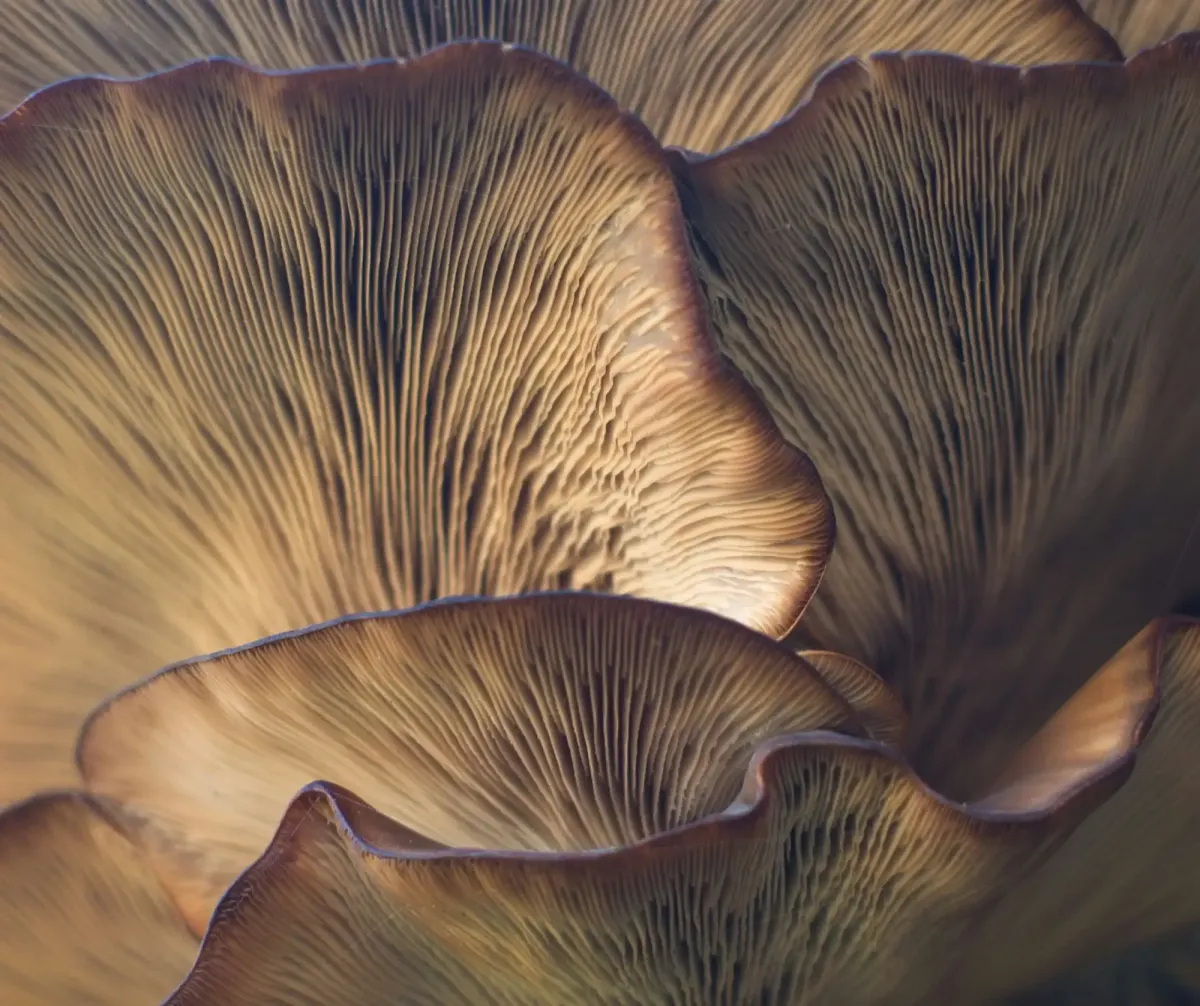
The mushrooms visible above ground are the reproductive structures of this underground network. When moisture and temperature conditions are favorable, they emerge along the expanding perimeter. Their caps disappear within days or weeks, while the mycelium continues to grow and produces new mushrooms in subsequent seasons.
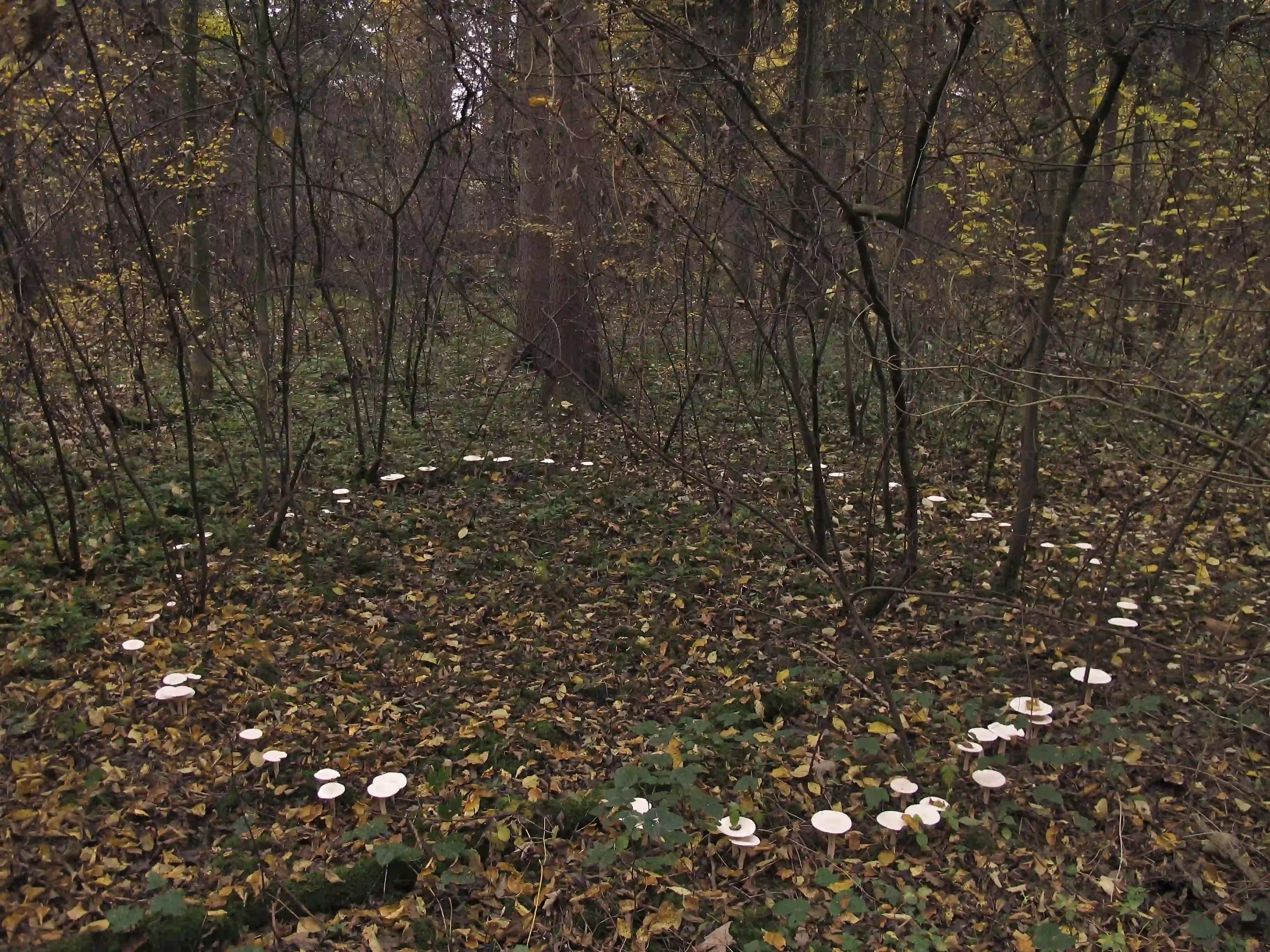
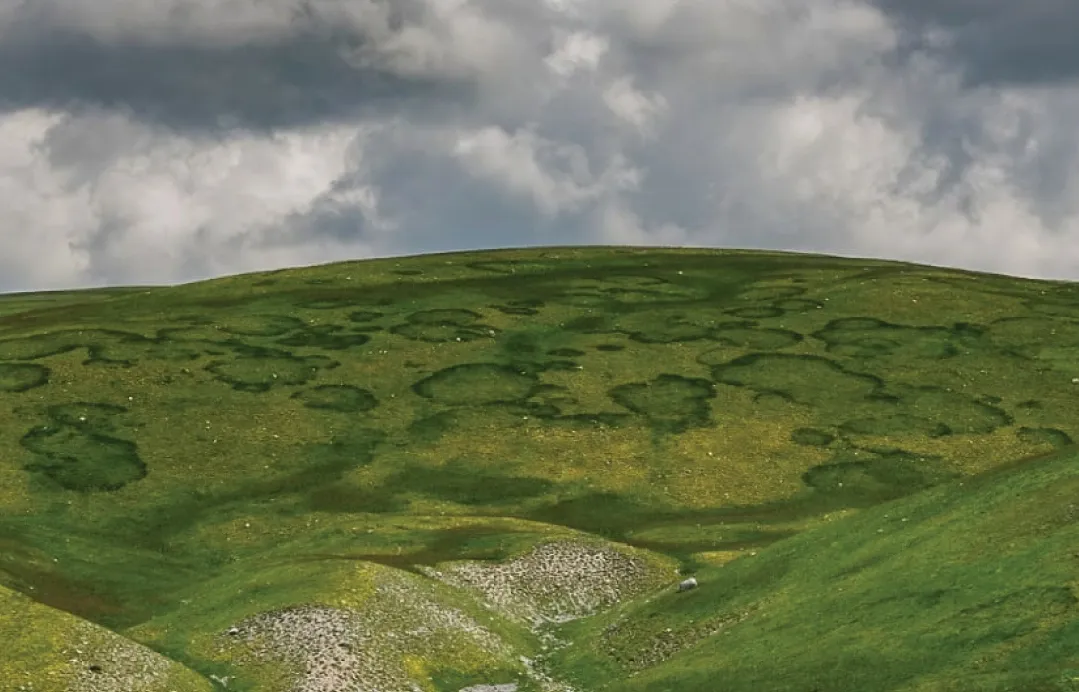
Not every colony forms a perfect circle. Soil conditions, tree roots, environmental obstacles and encounters with other fungal colonies alter the direction of growth. Some rings develop into semicircles, arcs or irregular bands. Others produce no visible mushrooms at all and can be identified only by changes in the color of the surrounding grass.
By the early nineteenth century, naturalists had begun linking these formations to the underground growth of fungi. Research conducted at England's Rothamsted Experimental Station in 1883 identified nitrogen enrichment in soils associated with fairy rings, helping explain the unusual patterns of vegetation around them.
Life and Death in the Same Soil
The grass surrounding a fairy ring can appear unusually vigorous. A band of deep green vegetation stands out against the paler meadow, sometimes bordered by another strip where the grass has turned brown and died.
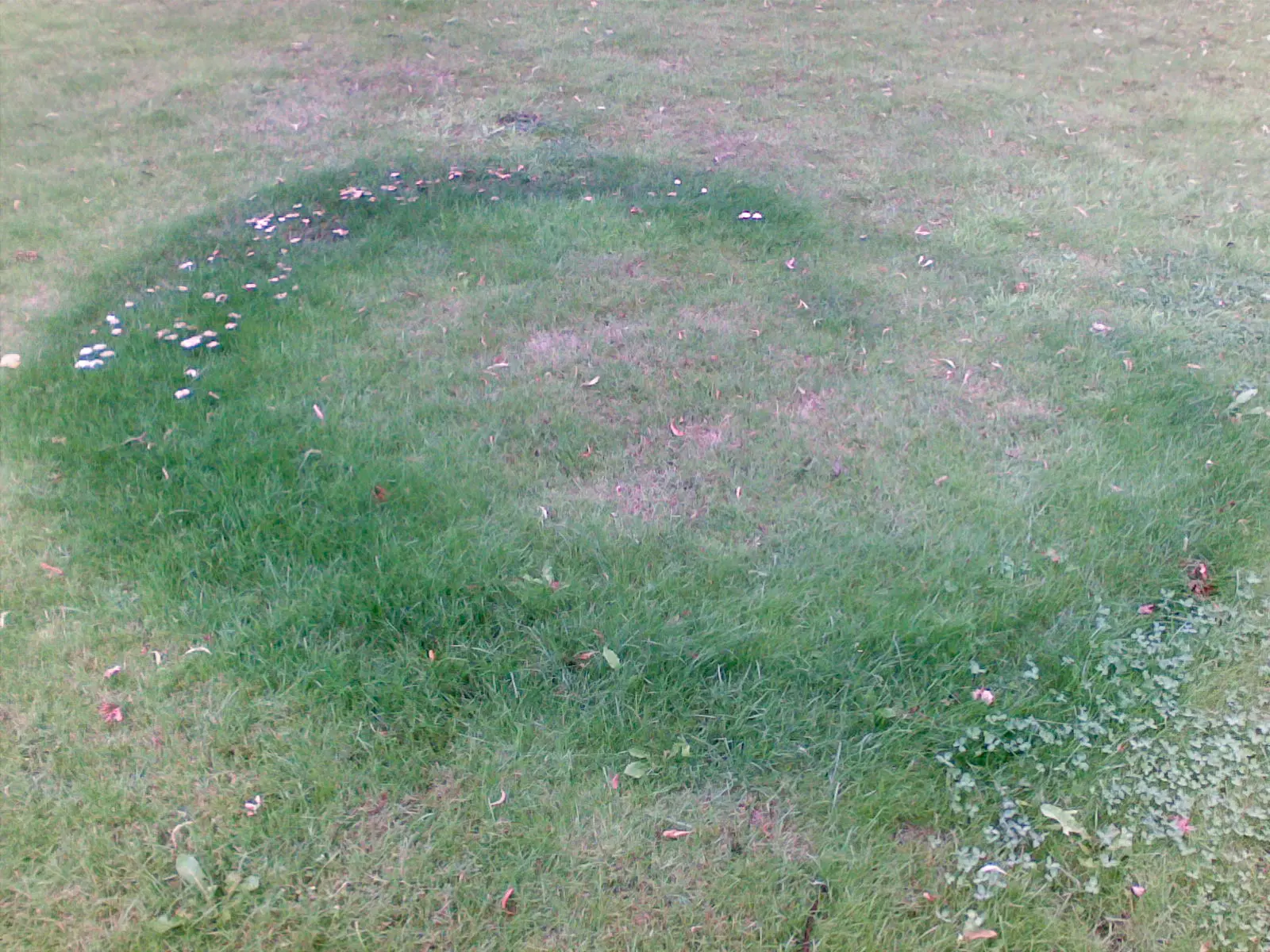
Both effects originate in the fungus beneath the surface. As mycelium breaks down organic material, nutrients released into the soil, particularly nitrogen, stimulate plant growth. At the same time, dense layers of fungal mycelium in some rings make the soil water-repellent, preventing moisture from reaching the roots. Grass dries out in one area while plants only a short distance away flourish.
In 1917, American researchers Homer Shantz and Richard Piemeisel systematically classified the different effects fairy rings have on surrounding vegetation. Their work helped establish the role of fungi in shaping plant communities and altering the physical and chemical properties of soil.
A comprehensive review published in IMA Fungus in 2025 examined fairy rings as examples of ecosystem engineering. Their advancing growth fronts influence soil moisture, nutrient cycling and microbial communities. Chemical compounds released by some fungi stimulate plant development, while others suppress it.
Researchers are also investigating why fungal colonies continue to expand outward rather than recolonizing their older centers. One proposed explanation involves DNA released by dead fungal cells, which may inhibit subsequent growth by the same organism. Mathematical models have reproduced circular growth patterns using this mechanism, although its role under natural conditions remains under investigation.
Five Centuries of Growth
A study published in Fungal Ecology in 2023 revealed just how long these formations can persist.
Steven Miller and Abbie Gongloff of the University of Wyoming examined 304 fairy rings in Wyoming's Laramie Basin. Using historical aerial photographs and Google Earth imagery spanning 1947 to 2022, they measured the dimensions and calculated the expansion rates of rings formed by eight fungal species.
The circles ranged from four to 272 meters in diameter. Most were relatively young, with an estimated 90 percent less than 80 years old. But the oldest ring had a calculated age of 522 years.
The figure was derived from growth rates rather than direct observation. It nevertheless provides evidence of fungal colonies persisting and expanding over timescales far beyond a human lifetime.
The estimated age of Wyoming's oldest ring places its origins near the beginning of the sixteenth century. Over the centuries that followed, its mycelium continued advancing through the soil, occupying new ground as older sections declined. Changes in rainfall, vegetation and surrounding conditions shaped its growth, while the visible mushrooms appeared and disappeared with the seasons.
Historical aerial photographs proved particularly valuable to the researchers. By comparing images taken decades apart, they could measure changes that would be almost impossible to recognize during an ordinary visit to a meadow.
The Visible and the Invisible
In European folklore, fairy rings were often understood as boundaries of another world. Fairies were believed to gather within them, and crossing their edges could expose humans to forces beyond their control. Their distinct outlines, together with mushrooms that seemed to appear overnight, made them particularly suited to such interpretations.
The scientific explanation eventually emerged from observations of the soil beneath those circles. In 1807, William Hyde Wollaston described the role of underground fungal growth. Later investigations connected the rings' appearance to changes in soil chemistry and vegetation.
Scientists still have questions about the processes involved. The mechanisms governing mycelial growth, interactions with other soil organisms and the different lifespans of fungal colonies remain active areas of research.
The oldest fairy ring identified in the Wyoming study was estimated to have begun growing around 1500. By the time members of the Royal Society were debating the origins of these circles in 1675, that colony had already been expanding for roughly 170 years.
The researchers reconstructed its extraordinary timescale using a record that earlier natural philosophers could never have consulted: aerial photographs taken across successive decades. From one image to the next, the position of a ring's advancing edge could be measured. What once appeared on the surface as a brief and mysterious arrangement of mushrooms was part of a biological process unfolding over centuries.
— Related Reading: The Myth of Design and What Nature's Tinkering Intelligence Teaches Us