Unsinkable Sam: The Most Bizarre Naval Case of World War II and the Collapse of Military Psychology
How many disasters must a creature survive to become a curse? In the bloodiest naval battles of WW2, a single cat walked away from three sinking warships. What started as a miracle soon spiraled into mass hysteria, exposing the fragile, terrifying collapse of military psychology.
How many disasters must a living creature survive before being stripped of the title "miracle" and branded a "curse"? Surviving the chaos of war is often attributed to strategic brilliance, technological superiority, or sheer physical endurance. Yet, in the bloodiest naval battles of World War II, there was only one "passenger" who managed to walk away from three colossal warships that plummeted to the bottom of the ocean. He was neither an admiral nor a decorated soldier. He was a black-and-white cat who never understood the war at all.
However, this mind-bending survival story did not merely survive as a cute anecdote in the dusty pages of naval history. Over time, in the minds of a crew living in constant fear of death, it spiraled into a massive psychological crisis, mass hysteria, and the ultimate surrender of rational thought to superstition. Meet one of the most controversial figures in maritime history: Unsinkable Sam.
The Fog of War and Wreckage in the Ocean
The naval history of World War II is fraught with ruthless games of cat-and-mouse played out in the freezing waters of the Atlantic Ocean. According to records that have since evolved into naval legends, it all began in May 1941, when the era's most terrifying German battleship, the Bismarck, was cornered and sunk by the British Navy after a relentless, days-long pursuit. Out of a crew of over 2,200 men aboard the ship that vanished into the dark depths, only 114 survived.
Hours later, the crew of the British destroyer HMS Cossack, patrolling the massive debris field left by the battle, encountered a surreal sight in the water: a soaking wet, black-and-white cat clinging tightly to a piece of floating wood.
Rescued from the enemy wreck, this nameless creature was pulled from the water by British sailors and christened "Oscar." Keeping mascots on warships is a long-standing and widespread tradition in maritime culture. For soldiers, these animals serve as rare anchors to normalcy and life in an environment far from home, where death is a constant presence. For the crew of the HMS Cossack, Oscar was exactly that: a tangible symbol of survival, pulled from the heart of destruction.
The Second Test and the "Unsinkable" Moniker
Oscar’s new career in the British Navy was ostensibly ordinary—until the HMS Cossack went on patrol in the treacherous waters of the Mediterranean. In October 1941, the ship was targeted by a torpedo fired by a German U-boat. As the heavily damaged destroyer sank into the sea, the rescue operations mirrored a desperate struggle for life in the middle of the ocean.
When rescue teams reached the wreckage, history repeated itself. Oscar was casually drifting on another ordinary piece of wood, seemingly entirely isolated from the destruction around him. This second escape caused his story to spread through the navy by word of mouth. He was no longer just a rescued enemy cat; he was a figure defying the unforgiving rules of the sea. When he was brought to the naval base in Gibraltar, British soldiers bestowed upon him his legendary moniker: Unsinkable Sam.
The Irony of History: HMS Ark Royal
Having walked away from two catastrophes without a single scratch, Sam had become a flawless symbol of hope for soldiers living in constant fear of torpedoes. Driven by this morale boost, he was transferred to one of the navy’s most prestigious aircraft carriers, the HMS Ark Royal. Yet, hidden here was one of history's most striking ironies: the Ark Royal was the very ship that had launched the fatal strike that sank Sam's first home, the Bismarck, months earlier.
The statistics and the laws of the sea did not change for Sam. Before long, this massive aircraft carrier also became the target of a torpedo. The giant vessel slowly rolled over and sank into the dark depths. During the search and rescue operations, Sam was pulled from the sea, described in official British Navy reports as "angry but quite unharmed." The debris he clung to was the same: an ordinary wooden plank left over from the sunken behemoth.
A Fracture in Mass Psychology: From Miracle to Curse
With the sinking of the third ship, the trajectory of the story changed completely. This point in the military history of World War II naval warfare exposes just how fragile human psychology can be.
In maritime folklore, people or objects believed to bring bad luck to a ship are called a "Jonah." After the sinking of the Ark Royal, Sam morphed into exactly that in the eyes of the naval crews. To the sailors, he was no longer an adorable symbol of survival; he was a sinister harbinger who dragged every ship he boarded to its doom, summoning storms and disaster. Rational reality (the fact that submarines were sinking the ships) rapidly gave way to a primal, collective fear.
In the horror of war, rational thought is often one of the first casualties. Soldiers tend to believe that survival depends entirely on luck or some invisible order. Driven by the instinct to survive, an entire British Navy cast rationality aside and began to fear a cat. No captain wanted him on their deck.
Where Myth Meets Reality: Illusions Forged by War
However, at this juncture, for the sake of historical integrity, we must take a step back and pierce the fog of war hanging over the ocean. Is this incredible story a flawless chronology, or is it a colossal myth constructed by traumatized human minds?
Naval historians and the records of the National Maritime Museum cast deep shadows of doubt over the tale. In the works of Ludovic Kennedy—one of the most authoritative and detailed sources on the sinking of the Bismarck—there is not a single line mentioning the presence of a cat on board. Official records of the German battleship do not list Oscar as a mascot.
Even more strikingly, most of the famous black-and-white cat photos circulating on the internet and in historical archives today under the title "Unsinkable Sam" are an illusion. The cat in those images, as written on its collar, is actually Simon, another feline who served on the HMS Amethyst in 1949 and whose heroics are far more clearly documented.
Does this mean Unsinkable Sam is entirely a work of fiction? Not exactly. Two plausible explanations emerge regarding Sam's presence on the Bismarck: He was either an undocumented stowaway who had sneaked aboard, or this narrative, spreading by word of mouth over time, was an amalgamation of several different sea tales (and the stories of other cats like Simon) forged by soldiers trying to cope with the profound psychological devastation of war. The "immortality" of a single creature provided a much-needed psychological sanctuary for thousands of sailors facing death every day.
A Quiet Farewell in Belfast
Fearing that the mass hysteria would spiral out of control, the naval command finally and permanently "retired" Sam from the seas. Sent far away from the torpedoes and the eerie waters of the Atlantic, the cat spent the rest of his life on land at a seaman's home in Belfast, Northern Ireland, passing away from old age in 1955.
Today, his iconic portrait, drawn in pastel by the artist Georgina Shaw-Baker, hangs in the National Maritime Museum in London. In the painting, those dark eyes that witnessed the ruthless cruelty of the ocean continue to gaze at visitors.
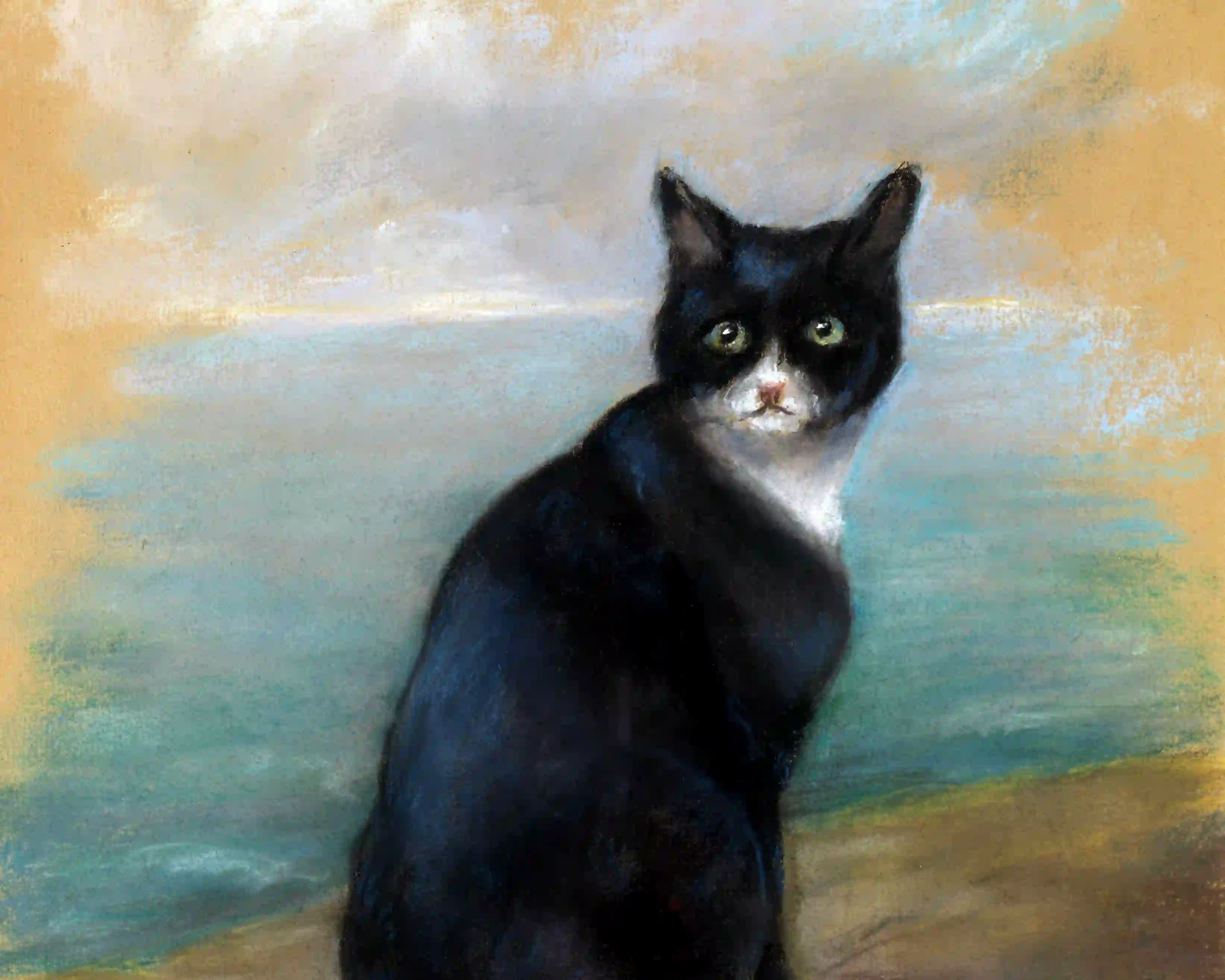
This most bizarre case in history leaves behind a daunting, unanswered question: Was it an absolute miracle of survival, or a deadly legend of a curse built by the hands of a desperate navy? Perhaps the true tragedy of war is that no one ever gets to decide who survives.
— Related Reading: The Collapse of the "One-Day Lifespan" Myth